http://www.scribd.com/doc/297836018/NYT-Parody
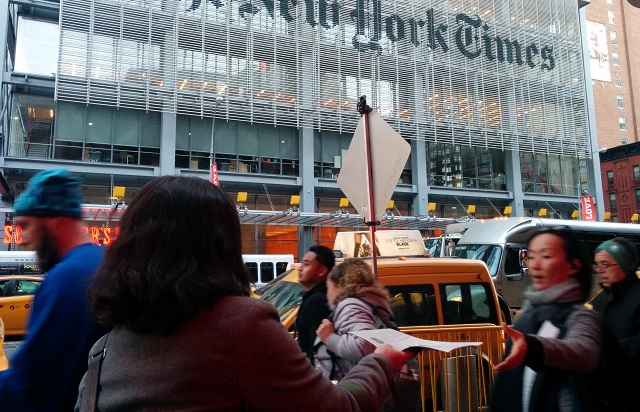
Ten thousand copies of a special supplement of The New York Times focused on Israel and Palestine were distributed across NYC February 2, 2016. The special parody supplement, created and distributed by Jewish Voice for Peace–New York chapter and Jews Say No!, included such articles as “Congress to Debate US Aid to Israel” and “In the Footsteps of Mandela and King: A Non-Violent Movement Gains Ground Ten Years On,” as well as an editorial, “Our New Editorial Policy: Rethinking Israel-Palestine.” The paper was intended to point out how biased current reporting is on Israel and Palestine and to show what a paper that was fair and accurate could look like.
More information at: jvp.org/itsnotthetimes and view the paper at: http://bit.ly/1VR2PhZ
FOR IMMEDIATE RELEASE
Contact:
Beth Miller | miller.bethavedon@gmail.com
Donna Nevel | denevel@gmail.com | 917-570-4371
(February 3, 2016)–Ten thousand copies of a special supplement of The New York Times focused on Israel and Palestine were distributed across NYC yesterday, while thousands of on-line versions made their way across the internet. The special supplement, which was a parody, includes such articles as “Congress to Debate US Aid to Israel” and “In the Footsteps of Mandela and King: A Non-Violent Movement Gains Ground Ten Years On,” as well as an editorial, “Our New Editorial Policy: Rethinking Israel-Palestine.”
Created by members of Jewish Voice for Peace New York (JVP NY) and Jews Say No!, (JSN), two NYC organizations devoted to justice in Palestine and Israel, the paper was created to “point out how biased current reporting is on Israel and Palestine and to show what a paper that was fair and accurate could look like,” according to JSN member Alan Levine, one of the paper’s writers.
“As a leading source for news in the United States and in the world, The New York Times has a responsibility to its readers to provide fair, balanced, and fact-based coverage. Our paper reflects the news that we wish The Times and other papers would report,” says Candace Graff, one of the organizers of the action from JVP NY. “It includes the context and facts too often missing from The New York Times and other U.S. media outlets.”
The articles highlight Israel’s ongoing policies of military occupation, displacement, and oppression, and “facts on the ground,” such as settlement expansion, the rise in settler violence, discriminatory anti-democratic laws targeting Palestinian citizens of Israel, and the increase of right-wing voices in the Knesset. “These are all subjects that deserve to be covered and reported on,” Graff added. In a nod towards how U.S. policy on Israel might change if the mainstream media reported fairly on the continuing human rights abuses against Palestinians, the paper includes an editorial that calls on Congress to condition further Israeli military aid on compliance with the Leahy Law, which forbids U.S. military aid to foreign units that have committed human rights abuses.
The two groups will release a brief video about the action tomorrow (2/4) that includes footage of the group distributing the paper on the streets of NYC. Jane Hirschmann, a member of Jews Say No!, and Ben Norton, a writer at Salon who first revealed the creators of the paper, discussed media bias around Israel/Palestine on Democracy Now this morning (2/3). The faux paper’s domain and twitter account were suspended, but can be viewed here and here.
Credits:
Editors: Elly Bulkin, Nina Felshin, Donna Nevel, Rosalind Petchesky
Designer, print edition: Sarah Sills
Designer, online edition: Asa Diebolt
Production, Online edition: Talia Baurer
Writers: Gordon Beeferman, Brandon Davis, Naomi Dann, Candace Graff, Alan Levine, Aurora Levins, Morales, Donna Nevel, Rosalind Petchesky, Ellen Ross, Lynn Lopez Salzedo, Carl Schieren, Irene Siegel, Pamela Sporn
Copyeditor: Dorothy Zellner
Videographers: Rona Merrill, Pam Sporn
Media team: Naomi Dann, Beth Miller, Donna Nevel
Distribution coordinators: Candace Graff, Jane Hirschmann
A large group of volunteers distributed the papers across the city.
The New York City chapter of Jewish Voice for Peace is part of a national, grassroots organization inspired by Jewish tradition to work for a just and lasting peace according to principles of human rights, equality, and international law for all the people of Israel and Palestine. Jewish Voice for Peace has over 200,000 online supporters, over 60 chapter, a youth wing, a Rabbinic Council, an Artist Council, and Academic Advisory Council, and an Advisory Board made up of leading U.S. intellectuals and artists. Jews Say No!, based in NYC, engages in community education, street theatre, and organizing, and makes their voices heard within the Jewish community and as partners in the broader movement for justice in Palestine/Israel.
“Congress to Debate U.S. Aid to Israel,” reads the front page of the latest edition of The New York Times — or, rather, the latest fake edition of the Times.
Activists from progressive Jewish human rights groups created a very convincing-looking fake edition of The New York Times to protest the leading newspaper’s coverage of Israel.
The parody publication is written from a left-wing, anti-racist, anti-Islamophobic perspective that criticizes Israel’s violations of international law and Palestinian human rights, along with what the groups say is the Times’ failure to adequately address these crimes.
Early Tuesday morning, the activists, under the name The New York Times, sent an email out to reporters across the country titled “NYT Announces New Editorial Policy: Rethinking Our Coverage of Israel-Palestine.” The email included a link to an entire website modeled on the Times’ own site, http://www.NewYorkTimes-IP.com, which the activists created.
Less than 24 hours after the site was made public, on Tuesday evening, it was taken down. It is archived here.
On the “NYT-IP” Twitter account the groups made, activists shared photos of them handing out more than 10,000 copies of a print edition of the paper for free in downtown New York City on Tuesday morning. This Twitter account was also suspended later that evening, but is archived here.

No group immediately took credit for the action on Tuesday, while reports filled the media.
Jewish Voice for Peace — New York and Jews Say No! informed Salon that they had organized the protest. The former is the local branch of Jewish Voice for Peace, or JVP, an American human rights and social justice organization that challenges the Israeli government’s continued violence against and oppression of the indigenous Palestinian people. Jews Say No! is a New York City-based peace group that, like JVP, protests Israel’s illegal 48-year occupation of the Palestinian territories and periodic heavy bombing of Gaza.
In December, during Hanukkah, both groups organized another campaign — a series of protests across the country condemning Islamophobia, racism, anti-refugee xenophobia and police brutality.
Throughout the past few months, JVP and Jews Say No! meticulously designed the fake four-page New York Times newspaper and website. They assembled more than 20 people and created an editorial team dedicated to creating top-quality, wittily written, fact-checked coverage.
The fake “special edition” issue carries the slogan “All the news we didn’t print,” and blasts the Times for what the activists see as its biased, pro-Israel coverage.
by Donna Nevel
http://www.alternet.org/world/new-report-shows-palestinian-movement-under-attack-us

As Israeli violence against the Palestinian people escalates, support across the globe for justice in Palestine, and calls in this country for the US government and corporations to stop facilitating Israel’s gross violations of international law and human rights, are increasingly common-place. However, rather than engage substantively about those well-documented violations, Israel’s defenders recklessly and baselessly smear Israel’s critics with charges of anti-Semitism, promoting terrorism, and seeking to “delegitimize” Israel.
It’s a tactic of long standing. For as long as I can remember, the Israeli government has had a well-orchestrated hasbara (propaganda) campaign directed at those who protest Israel’s unjust treatment of the Palestinian people. More recently, with the growth of the movement to hold Israeli accountable for its human rights violations through Boycott, Divestment, and Sanctions (BDS), these attacks have intensified dramatically. They are being fueled with enormous sums of money and resources from the Israeli government, some American Jewish organizations, and the likes of Sheldon Adelson and others.
These campaigns are largely directed at college campuses where consistent, bold, and creative organizing is ongoing against Israel actions and against university complicity in supporting Israeli crimes. Those whose views are considered unacceptable to Israel’s supporters have been targeted with personal and ad hominem attacks that include, but are not limited to, intimidation, campaigns to get professors fired, and ongoing harassment. When speaking on college campuses, I was told story after story of students who were hesitant to speak out because of fear of reprisals. Further, accusations of “creating hostile environments” or being “uncivil–ironic as they are—are yet another attempt to derail the call for equality, for accountability, and for fairness.
Last week, Palestine Legal [1] and the Center for Constitutional Rights [2] (CCR), which work with students and academics throughout the US, released a report (“The Palestine Exception to Free Speech: A Movement Under Attack in the US” [3]) that systematically documents the growing suppression, on US campuses, of advocacy on behalf of Palestinian human rights. Describing nearly 300 incidents of such suppression in a period of a year and a half, the report describes false accusations of anti-Semitism and terrorism; baseless legal complaints and administrative disciplinary actions; firings of professors; and ongoing harassment and intimidation targeted at students and scholars across the country.
The report calls on university administrators, as well as federal and state lawmakers, to remember that universities are places in which vigorous debate on issues of public policy is expected and should be encouraged; that criticism of Israel, a nation state, is not the same as anti-Semitism; and where First Amendment rights must be scrupulously safeguarded. The report specifically calls on administrators to listen to students on their campus who are victims of such tactics and to insure that all legislative and governmental bodies—including the State Department and Office of Civil Rights—are vigilant in distinguishing criticism of Israeli policies from anti-Semitism.
At the same time as the CCR and Palestine Legal have released their report, Jewish Voice for Peace [4], which works for peace and justice in Palestine and Israel, has also released a report (“Stifling Dissent: How Israel’s Defenders Use False Charges of Anti-Semitism to Limit the Debate on Campus”) [5] describing attempts by Israel’s supporters to control debate about Israel and Palestine on US campuses. It particularly documents the ways that Muslim and Arab students are being targeted. JVP’s report discusses at length the bullying tactics (toward those speaking out against Israeli policies) being employed by a range of American Jewish organizations; how Israel support groups are abusing student government, as well as changing and creating policies and regulations, to silence debate; and the smear campaigns against faculty through battles over hiring and tenure. As part of the report, an overview is provided of the Jewish organizations that participate and promote such tactics. At the report’s end, recommendations are offered for insuring that these tactics are not allowed to rule the day along with descriptions of organizations that can offer resources and support when needed.
Both reports make clear that the movement for justice for the Palestinian people is growing not just on campuses but nation-wide—in fact, world-wide—and that universities must resist, not participate in promoting and supporting, unethical and illegal strategies to silence debate and, worse, destroy those who have the courage to act with integrity and speak out against Israeli brutality.
Philip Weiss on Mondoweiss March 31, 2015
This is the story of a tragedy inside the Jewish community.
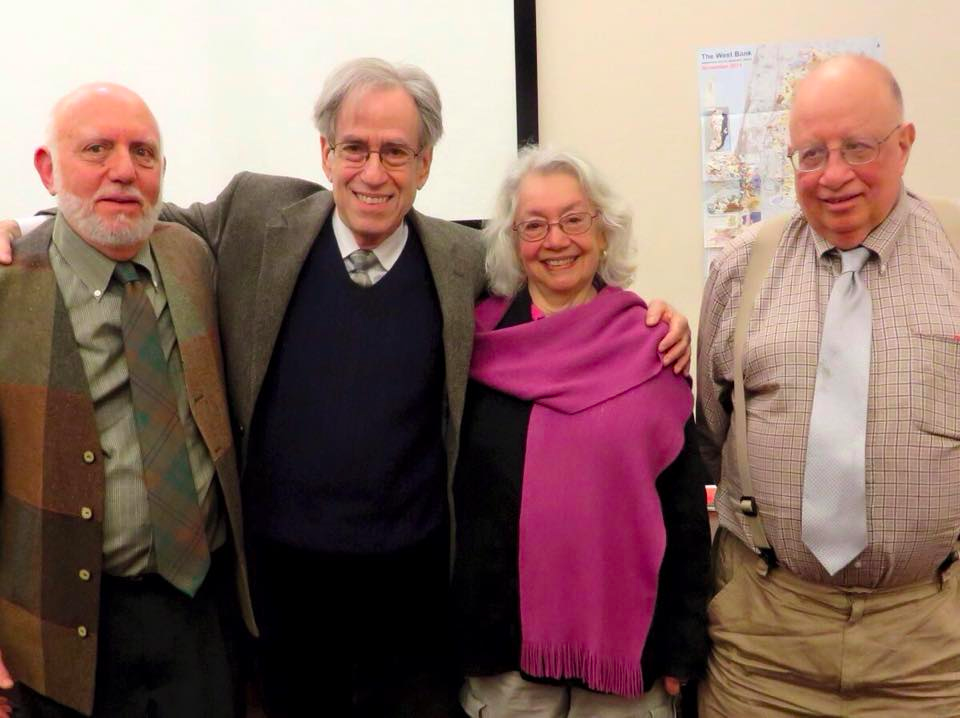
The four American Jews above are on a national campus tour. All in their 70s, they are veterans of the civil rights movement; they went south 50 years ago to help free our country from Jim Crow, risking their lives for equal rights.
But they have been banned from speaking at Hillel, the Jewish campus organization, because they have come out in favor of Palestinian human rights.
Last Wednesday they were to speak at Swarthmore Hillel, but the gangster who runs Hillel, former congressman Eric Fingerhut, hinted at legal action if the students dared to let them speak– so the students had to start a new Jewish group called Kehilah just to hear them.
Eric Fingerhut, the head of Hillel International. (Photo: Shahar Azran for Hillel)
The next night they spoke to an overflow crowd at Muhlenberg College, introduced by former Hillel president Caroline Dorn. Dorn had to quit Hillel in order to host them—and she also had to meet with the college provost even to get permission for the four to come on campus because the college administration was afraid of alienating Jewish students. “It was devastating,” she says. And last night they spoke to more than 100 at the University of Michigan. Again: barred from Hillel.
So these four travelers are freedom riders twice. First in their 20s in the civil rights movement, now in their 70s, sponsored by the Open Hillel movement.
“Why are they so afraid about what a bunch of old folks are going to say to you?” Mark Levy asked at Swarthmore.
Why? Because when I saw them at Swarthmore, three of them started to weep as they told their stories, even 50 years later. Why? Because they witnessed an American social revolution in which many people suffered, and they are extending that experience to Palestine.
Levy is the man on the left. A retired teacher in New York, he went south because he thought the best way to fight anti-semitism was to fight discrimination against all people.
Next to him is Larry Rubin. Rubin went south “automatically” from the Sholom Aleichem Club in Philadelphia 50 years ago because “I wanted to make my country better.” But in Belzoni Mississippi, a sheriff said to him, “We haven’t hanged us a Hebe in a long time” and the white people said he was trying to “destroy” the country. The same charge was hurled at him when he went to Palestine and witnessed the apartheid conditions there.
Next in line, Dorothy Zellner. Like Rubin, she worked for SNCC, the Student Non Violent Coordinating Committee. She went south because she believed Jews fought injustice in the garment industry, in the Spanish Civil war, in the Warsaw Ghetto, because the Talmud told them to:
“Who is honored? The one who honors all human beings.”
On Zellner’s left is the baby of the group, Ira Grupper. He grew up Orthodox in Brooklyn, and twice he broke down last week as he spoke. First when he said that he had named his daughter after his friend Vernon Dahmer, who was murdered in Mississippi for helping black people to vote. The second time when he told of his arrest with hundreds of other men at the Mississippi Fairgrounds, and every night as a form of humiliation and control the cops served the white prisoners their bologna sandwich and cup of milk first but every prisoner set the cup on the floor with the sandwich on top of it till the last black prisoner was served.
“Then all of us prisoners, black and white together, picked up our sandwiches as one, and that is what the civil rights movement means to me, and as a Jew I have to fight for the rights of all people and that includes Palestinians.”
You’d think that these four Jews would be hallowed by the Jewish community, that Grupper would be telling his stories at the 92d Street Y and the DC JCC and the Center for Jewish History in New York. No: they are pariahs, because they speak out for Palestine, and cross Hillel International’s red lines for accepted speech.
The night I saw them was tense. Joshua Wolfsun of Kehilah warned the crowd, you may disagree vehemently with what you are about to hear, but please try and listen resiliently and if you have to blow off steam, take a walk outside. A rabbi who sat near the back asked what was the difference between blind loyalty to Israel that the group was opposing and support for the Jewish people. An older man said equal rights and civil rights and peace are all great, but what do you owe the Jewish community?
Levy said the demand is something out of the Spanish Inquisition. “There’s a single definition of being Jewish: I have to be a Zionist, 110 percent uncritical of Israel, otherwise I can’t call myself a Jew. And I think there’s something wrong with that.”
Rubin said the thought control reminds him of Communist days, when friends said he should never criticize the Soviet Union because Russia was the savior of the working class, and criticism would hurt the movement.
“Now Israel is the savior of the Jewish community so don’t say anything. Israel is supposed to be a Jewish country–and they don’t want Jews to argue? This is not the way that Jews do business.”
Zellner said Israel is not a Jewish country, any more than the U.S. was a white country when 12 percent of the country was black. But she said the demands of Jewish nationalism have made Jews sick.
“What’s happening now in the Jewish community, the enforced loyalty to the state of Israel, has made us sick. We are a sick population, we are under such extreme tension. We have people storming out of seder meals, and we in Jews Say No, when we’re out on the street. I have seen normal people who you would not look at twice go from zero to 60 in a second and become raving maniacs. Calling us everything that you can possibly say. We are in a situation where people can’t ask the questions and they can’t talk. “
She said the young Jews in the room were the “prize” that the older Jews are fighting over, and the Fingerhuts will lose.
“You signal the end of the occupation. I am the oldest one here. I will tell you my age, I’m 77, and I am going to be live to the end of this occupation. You all have done the final blow. When hundred of J Street student went outside of Fingerhut’s office [to protest restrictions], this is the end, the ship is going down and it’s because of you guys..”
Others on this site are not as thrilled as I am by this movement. They say it’s fine for Jews to save the Jewish soul, but that’s not going to bring justice to Palestine. I say we need to change the Jewish community, because we hold the keys to changing U.S. policy. One thing we agree about, the Jewish community is reactionary when it comes to Palestinian rights; and these four Jews in their 70s are working with Jews in their teens and 20s to try and change that culture.
Dorothy Zellner said the Jewish establishment miscalculated, promising its loyalty to Israel, saying, “We are all in lockstep. But we’re not.” The young people are breaking those chains and the Fingerhuts and Foxmans are terrified of the change. And when the change happens American public opinion will break.
The young Jews issued a statement of their own yesterday. After the threats to Swarthmore and the resignation of Caroline Dorn, the Open Hillel movement issued a calm challenge to their elders:
Hillel is facing a choice – it can continue to spend valuable resources devoted to fighting its own students in an attempt to dictate what students can and cannot say about Israel/Palestine, or it can return to its mission of engaging Jewish students.
The vets will be at the University of Chicago on April 1st. We’ll announce additional stops on the midwest tour when we learn about them. And then they hit the South, April 15-18.
The Jewish establishment has banned these four valiant Jews. Why?
One of the things that I kept hearing this past weekend at the Jewish Voice for Peace National Membership Meeting (JVP NMM) was how people felt pushed in their thinking. Guided by the weekend’s theme — We’re not waiting — more than 600 people from across the country gathered both to envision the future and think concretely about how to be as meaningfully engaged as possible with the movement for justice in Palestine.
The weekend was intergenerational, inspirational, challenging, and, most significantly for me, had us all struggling with issues — from Boycott, Divestment, and Sanctions (BDS) and Assaults on Academic Freedom to Islamophobia and Challenging Militarization and Police Violence — in new ways and more intentionally recognizing and building upon the intersections among the various parts of our work and organizing.
Plenary sessions, which included JVP leaders along with deep thinkers and activists Sa’ed Adel Atshan, Reverend Dr. Heber M. Brown III, Amer Shurrab, Andrea Smith and others — helped lay the groundwork for the weekend. Amer Shurrab stated in the opening plenary, which was echoed by others throughout the weekend, that peace and justice required, quite simply and directly, equal rights for all. Reverend Brown, who had recently been to Palestine and Israel, spoke with tremendous passion about how to engage in our inter-connected work for justice: “It is important that struggles engage in deep listening and allow themselves to be transformed by each other.” Back and forth between theoretical analyses and concrete strategies for action, their words clearly resonated with an audience of energetic and committed people.
The Nakba and right of return were also centered throughout the weekend, with presentations by Basem Sbaih from Badil and Liat Rosenberg from Zochrot, which reflected a commitment to insuring that these foundational issues would not simply be an “add-on” to other discussions. Rosenberg stated with clarity: “The Nakba was not a one-time event in 1948; it is ongoing,” with further emphasis by Sbaih. “We have to be honest, this work is really hard. The displacement of Palestinians is ongoing today.”
People seemed anxious to learn more, to connect with others engaged in this work, and to deepen their own analysis that would help shape and inform their organizing.
I thought Andrea Smith’s thinking and analysis were transformative and helped lift us to a new level. She spoke of the struggles and challenges of Native peoples in this country — one that is ongoing — and about the importance of understanding colonization in all its manifestations. She also spoke about the importance of envisioning what is possible in new and expansive ways.
Well over 100 college students attended the meeting. I spent time with lovely, committed students from Guilford College and Pitzer College, all of whom are involved with SJP on their campuses. They are facing formidable challenges from those on their campuses who want to shut down their organizing and silence the position that supports justice for Palestine, but they will not be deterred. Responding to attacks from members of the local Jewish community and from Hillel that her college isn’t safe for Jewish students because they bring in pro-Palestine speakers like Steven Salaita, Guilford College student Sara Minsky recently wrote a letter explaining why she feels safe as a Jewish student at Guilford precisely because of its stated commitment to fostering critical, open discussion about Palestine/Israel.
JVP’s role in the broader movement was also interwoven into numbers of discussions. People spoke about how to be an effective and responsible and responsive partner in a Palestinian-led movement; to continue to grow and deepen its work in Jewish communities across the country; to be intentional and bold. At the final plenary, Angela Davis spoke about the importance of JVP’s leadership and the pivotal role of JVP in conjunction with movements against racism in the U.S., while also stressing the importance of leadership coming from communities of color.
The weekend was not without its tensions or differences. From quite different perspectives on the nature and reality of anti-Semitism today and whether it should be integrated into JVP’s work to those struggling with the specifics and actual meaning of the right of return and the articulated concept of dezionizing Israel, probing discussion and debate on these and other issues continued well after the sessions had ended.
The most powerful part of the meeting for me was what felt like a wide-spread recognition that all that was generated throughout the weekend would become part of the thinking, the strategizing, and the organizing after it ended. And that JVP is doing its work in concert with, and as part of a global movement for racial justice that truly spans from Ferguson to Palestine.
*I am a member of JVP’s board of directors.
http://www.huffingtonpost.com/donna-nevel/reflections-on-a-national_1_b_6907006.html

On the eve of an important event to discuss the Nakba* scheduled to take place this evening, the Executive Director of a tony uptown synagogue in New York City where the event was contracted to take place has attempted to cancel the event with no explanation in what can only be perceived as an effort to shut down discussion of the “ongoing Nakba” within the Jewish community.
The event was to feature the Palestinian human rights organization, Badil (whose timely recently released Corporate Complicity in Violations of International Law in Palestine [pdf] is a must read), and Israeli human rights organization Zochrot. It is part of multi-city speaking tour, and was sponsored in New York by four organizations: Jewish Voice for Peace-New York; Nakba Education Project; Jews Say No!; and the National Lawyers Guild Palestine Subcommittee.
Prior to LSS Executive Director Ben Keil signing a contract to rent space for the event and accepting a $600 payment, Gail Miller of Jews Say No! made clear the event was “an opportunity for an Israeli group and a Palestinian group to talk about their work”, and expressly emphasized in writing “we need to be sure that somewhere down the line there won’t be a problem.”
Thusly, Keil responded, “For a rental like this, I’m not particularly concerned about the political stance of your program.”
So what happened? Yesterday Miller received an apologetic email from Keil “I’m sorry, but we cannot host your event at Lincoln Square Synagogue.”
Civil rights attorney and Jews Say No! member Alan Levine, informed Keil returning the rental fee did not relieve the LSS of its contractual obligations and warned him the sponsoring organizations retained their right “to pursue appropriate legal remedies” urging the synagogue to reconsider.
The last-minute cancellation has sparked outrage in the community. “We encourage the pursuit of justice” stated Candace Graff from Jewish Voice for Peace-NY , “it is precisely these kinds of open discussions that we claim to value in the Jewish community yet many synagogues and other Jewish institutions are shutting down fundamental discussions about how to achieve it.”
The sponsoring organizations, who represent hundreds of New Yorkers, are holding a protest tonight in front of Manhattan’s first new temple in 50 years, the Upper West Side’s landmark Lincoln Square Synagogue, at 6PM.
Thankfully undeterred, the organizers have found a new venue. Advent Lutheran Church (2504 Broadway, corner of 93rd St. and Broadway) has offered to host the event which will take place on schedule tonight at 7 PM after the protest.
The timing of the LSS cancellation is auspicious. Julia Kessler of the Nakba Education Project, one of the organizations sponsoring the event, said: “Given the election results in Israel, in which it is clearer than ever that Israel is becoming increasingly anti-democratic and unapologetic in its occupation of the Palestinian people, it’s obvious that we have to do more talking, not less, about the crucial issues like the Nakba and what happened in 1948 and how its effects are being felt, even today. Shutting down discussions and closing the doors to differing views will not help us to arrive at justice for all peoples.”

*Nakba, means “catastrophe” in Arabic and refers to the forced displacement of Palestinians that began with Israel’s establishment in 1948, and continues to this day.
Ever since police killed an unarmed black teenager in Ferguson, Mo., last August, it seems that every facet of the issue has come under scrutiny in The New York Times: police equipment, police militarization, grand juries, racial disparities, training, trust, local politics and profiling. But one element is missing from nearly all the column inches devoted to this topic—the Ferguson-Israel connection.
Others are talking about this, however, including protesters who took to the streets after the shooting and again when a grand jury refused to indict the officer who killed the teen. In Ferguson some taunted police saying, “You gonna shoot us? You gonna shoot us? Is this the Gaza Strip?” Protesters on the Manhattan Bridge chanted, “From Ferguson to Palestine, occupation has got to go,” and at least one of them held a sign that read “We are FERGUSON We are GAZA, because We are Human.”
The staunchly pro-Israel Anti-Defamation League has reported this development with alarm, listing nearly 20 separate U.S. groups that have emphasized the link between Israeli and American police abuse. Commentators in Israeli newspapers (here and here) have taken up the issue, as well as media outlets in the United States.
But the Times has avoided the topic, with one exception: Blogger Robert Mackey reported that Palestinians tweeted advice to protesters on how to deal with tear gas; he also published the taunts to police in Ferguson. However, his blog, “Open Source,” does not appear in print nor does it receive prominent play online, and his post failed to pursue another, deeper connection between Israeli security forces and U.S. law enforcement—“counter-terrorism” police training under Israeli instruction.
The newspaper has reported charges that U.S. police have become overly militarized andran at least one story (in 2005) about Israeli training of American police, but in the recent discussion about militarized police, it has made no mention of the pervasive Israeli influence on local departments.
Since 2004, the Jewish Institute for National Security Affairs, has sent9,500 “law enforcement executives” to study with Israeli police, army and intelligence services. The Anti-Defamation League and the American Jewish Committee’s Project Interchange also sponsor these trips. In addition, Israeli security officers come to the States to give training sessions, Israeli police maintain an office in New York City and the NYPD has an office in Tel Aviv.
The curriculum includes dealing with terrorist operations, transit security, intelligence sharing, surveillance and crowd control during protests. Suppressing protests is a large part of the training, and U.S. police tactics have become a “near replica” of their Israeli counterparts, according to community leader Shakeel Syed of Southern California.
“Whether it is in Ferguson or L.A., we see a similar response all the time in the form of a disproportionate number of combat-ready police with military gear who are ready to use tear gas at short notice,” he said. “Whenever you find 50 people at a demonstration, there is always a SWAT team in sight or right around the corner.”
An Amnesty International report, “Trigger Happy: Israel’s Excessive Use of Force in the West Bank,” has charged Israeli forces with lethal actions in the face of demonstrators who pose no threat to soldiers. The report cited “willful killings” of some protesters, which amount to war crimes, and “virtual impunity” for those responsible.
Nevertheless, American police speak with admiration of Israeli practices. A Maryland officer trained in Israel told former Israeli soldier Eran Efrati(now a dissident and outspoken critic of the army), “Oh, man, you guys are badasses. You guys are the best!” Former U.S. Capitol Police Chief Terrance Gainer has said that “Israel is the Harvard of antiterrorism.”
A recent Center for Investigative Reporting story underscores the effect of this training on U.S. police. It states, “The most tangible evidence that the training is having an impact on American policing is that both countries are using identical equipment against demonstrators, according to a 2013 report by the Israeli human rights organization B’Tselem and photographs of such equipment taken at demonstrations in Ferguson and Oakland and Anaheim, California.”
During 2011 Occupy protests in Oakland, U.S. army veteran Scott Olsen was shot in the head with a bean bag round and left with a permanent brain injury. His experience echoes that of protesters in occupied Palestine who have been killed or injured after being hit by “non-lethal” tear gas canisters. Two victims permanently disabled by these projectiles are Americans—Tristan Anderson and Emily Henochowicz, both wounded in the West Bank.
Oakland has a strong connection with Israeli police and army methods.Alameda County Sheriff Greg Ahern trained in Israel and instituted the annual Urban Shield weekend, in which police forces compete in mock “terrorist attack” exercises. Israel joins local departments in this event and has often taken first place in the competition.
In 2011 journalist Max Blumenthal called the pervasive Israeli influence on U.S. police tactics the “Israelification of America’s security apparatus.” This year others are also making the connection in light of Ferguson.
Ali Winston of the Center for Investigative Reporting wrote about the effect of Israeli training in a piece titled “U.S. police get antiterror training in Israel on privately funded trips,” and journalist Rania Khalek of The Electronic Intifada took up the issue in “Israel-trained police ‘occupy’ Missouri after killing of black youth.” Kristian Davis Bailey published a story in Ebony titled “The Ferguson/Palestine Connection”and noted that “Israel has played a role in the militarization of American police.”
All this is worth mention in the Times, but it prefers to look elsewhere in the discussions of police brutality and militarization within the United States. Its 2005 story on Israeli training was apparently never repeated. Now that the effects of this training could be cause for scandal, it has opted for silence.
 Jews Say No: Not In Our Name!