Posts Tagged ‘Israel’

Jewish Groups Stand in Opposition to Hate Speech and All Forms of Islamophobia

April 28, 2015

FOR IMMEDIATE RELEASE

Contact:  

Naomi Dann 845-377-5745      

Donna Nevel denevel@gmail.com

4/28/15        Jews Against Islamophobia Coalition stands strongly in opposition to Islamophobia in all its manifestations. Most recently, the courts ruled that Pamela Geller has the right to put up her virulently anti-Muslim ads on public buses. As a community, we will make our voices heard as forcefully as we can in protest of Islamophobic hate speech.

“The minute I read Geller’s language for the ads,*  I was reminded of the history of accusations of blood libel against the Jewish community that provoked, and fed into, anti-Semitism,” said Marjorie Dove Kent, executive director, Jews for Racial and Economic Justice.

According to Rosalind Petchesky from Jewish Voice for Peace-New York, “These ads are bad enough in and of themselves. But, this hate speech also operates within the context of continued discriminatory surveillance of the Muslim community. And I have seen the pernicious effects this had had on Muslim and Arab students at CUNY, where I have been a professor for many years. That is why we pledge to continue our work with Muslim groups and others concerned with state-sponsored discrimination against the Muslim community.”

Geller is the lead instigator and public face of a nationwide anti-Muslim ad campaign. She co-founded, with Robert Spencer, three groups designated as anti-Muslim hate groups by the Southern Poverty Law Center. The American Freedom Defense Initiative (AFDI), one of these groups, is the sponsor of the ads.

Geller’s ad campaigns most often explicitly link Israel with Islamophobia through images and words that smear Muslims and Palestinians. These campaigns have engendered bold and creative opposition by a wide range of communities—and this time will be no different.

JAIC calls upon the Jewish community—together with all communities– to speak out loud and clear against these bus ads and to demand the full civil and human rights of the Muslim community. *

*The ad reads: Killing Jews is Worship that draws us close to Allah.

Jews Against Islamophobia can be reached at jewsagainstislamophobia@gmail.com.

The Jewish establishment has banned these four valiant Jews. Why?

April 1, 2015

 Philip Weiss on Mondoweiss March 31, 2015 

33122987-7115-4018-b5d9-6c48c84b45e2


This is the story of a tragedy inside the Jewish community.

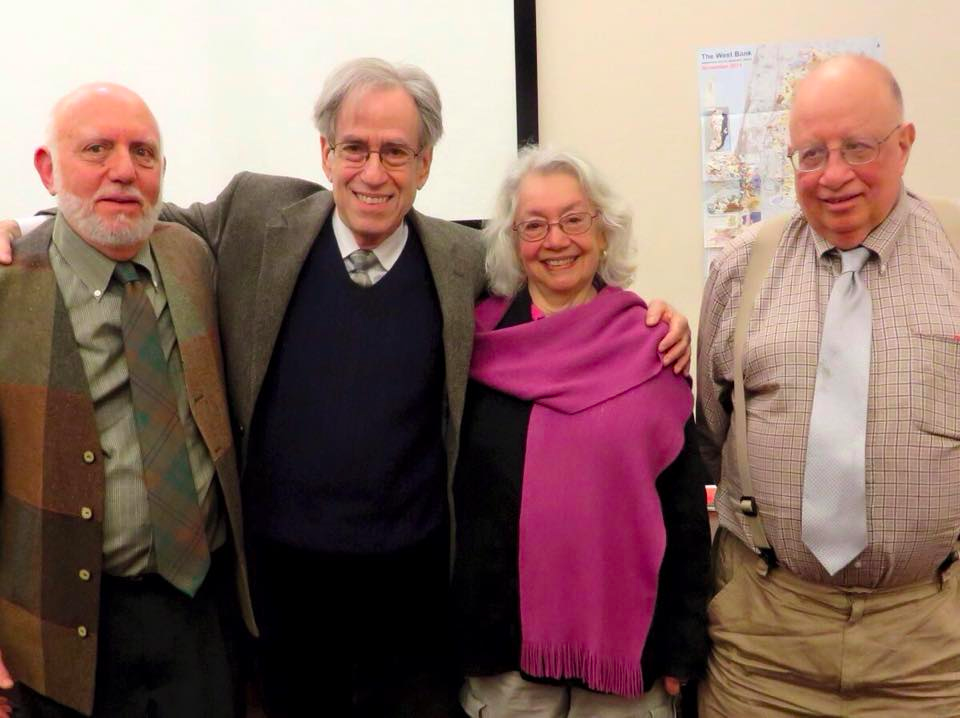
The four American Jews above are on a national campus tour. All in their 70s, they are veterans of the civil rights movement; they went south 50 years ago to help free our country from Jim Crow, risking their lives for equal rights.

But they have been banned from speaking at Hillel, the Jewish campus organization, because they have come out in favor of Palestinian human rights.

Last Wednesday they were to speak at Swarthmore Hillel, but the gangster who runs Hillel, former congressman Eric Fingerhut, hinted at legal action if the students dared to let them speak– so the students had to start a new Jewish group called Kehilah just to hear them.

Eric Fingerhut, the head of Hillel International. (Photo: Shahar Azran for Hillel)

The next night they spoke to an overflow crowd at Muhlenberg College, introduced by former Hillel president Caroline Dorn. Dorn had to quit Hillel in order to host them—and she also had to meet with the college provost even to get permission for the four to come on campus because the college administration was afraid of alienating Jewish students. “It was devastating,” she says. And last night they spoke to more than 100 at the University of Michigan. Again: barred from Hillel.

So these four travelers are freedom riders twice. First in their 20s in the civil rights movement, now in their 70s, sponsored by the Open Hillel movement.

“Why are they so afraid about what a bunch of old folks are going to say to you?” Mark Levy asked at Swarthmore.

Why? Because when I saw them at Swarthmore, three of them started to weep as they told their stories, even 50 years later. Why? Because they witnessed an American social revolution in which many people suffered, and they are extending that experience to Palestine.

Levy is the man on the left. A retired teacher in New York, he went south because he thought the best way to fight anti-semitism was to fight discrimination against all people.

Next to him is Larry Rubin. Rubin went south “automatically” from the Sholom Aleichem Club in Philadelphia 50 years ago because “I wanted to make my country better.” But in Belzoni Mississippi, a sheriff said to him, “We haven’t hanged us a Hebe in a long time” and the white people said he was trying to “destroy” the country. The same charge was hurled at him when he went to Palestine and witnessed the apartheid conditions there.

Next in line, Dorothy Zellner. Like Rubin, she worked for SNCC, the Student Non Violent Coordinating Committee. She went south because she believed Jews fought injustice in the garment industry, in the Spanish Civil war, in the Warsaw Ghetto, because the Talmud told them to:

“Who is honored? The one who honors all human beings.”

On Zellner’s left is the baby of the group, Ira Grupper. He grew up Orthodox in Brooklyn, and twice he broke down last week as he spoke. First when he said that he had named his daughter after his friend Vernon Dahmer, who was murdered in Mississippi for helping black people to vote. The second time when he told of his arrest with hundreds of other men at the Mississippi Fairgrounds, and every night as a form of humiliation and control the cops served the white prisoners their bologna sandwich and cup of milk first but every prisoner set the cup on the floor with the sandwich on top of it till the last black prisoner was served.

“Then all of us prisoners, black and white together, picked up our sandwiches as one, and that is what the civil rights movement means to me, and as a Jew I have to fight for the rights of all people and that includes Palestinians.”

You’d think that these four Jews would be hallowed by the Jewish community, that Grupper would be telling his stories at the 92d Street Y and the DC JCC and the Center for Jewish History in New York. No: they are pariahs, because they speak out for Palestine, and cross Hillel International’s red lines for accepted speech.

The night I saw them was tense. Joshua Wolfsun of Kehilah warned the crowd, you may disagree vehemently with what you are about to hear, but please try and listen resiliently and if you have to blow off steam, take a walk outside. A rabbi who sat near the back asked what was the difference between blind loyalty to Israel that the group was opposing and support for the Jewish people. An older man said equal rights and civil rights and peace are all great, but what do you owe the Jewish community?

Levy said the demand is something out of the Spanish Inquisition. “There’s a single definition of being Jewish: I have to be a Zionist, 110 percent uncritical of Israel, otherwise I can’t call myself a Jew. And I think there’s something wrong with that.”

Rubin said the thought control reminds him of Communist days, when friends said he should never criticize the Soviet Union because Russia was the savior of the working class, and criticism would hurt the movement.

“Now Israel is the savior of the Jewish community so don’t say anything. Israel is supposed to be a Jewish country–and they don’t want Jews to argue? This is not the way that Jews do business.”

Zellner said Israel is not a Jewish country, any more than the U.S. was a white country when 12 percent of the country was black. But she said the demands of Jewish nationalism have made Jews sick.

“What’s happening now in the Jewish community, the enforced loyalty to the state of Israel, has made us sick. We are a sick population, we are under such extreme tension. We have people storming out of seder meals, and we in Jews Say No, when we’re out on the street. I have seen normal people who you would not look at twice go from zero to 60 in a second and become raving maniacs. Calling us everything that you can possibly say. We are in a situation where people can’t ask the questions and they can’t talk. “

She said the young Jews in the room were the “prize” that the older Jews are fighting over, and the Fingerhuts will lose.

“You signal the end of the occupation. I am the oldest one here. I will tell you my age, I’m 77, and I am going to be live to the end of this occupation. You all have done the final blow. When hundred of J Street student went outside of Fingerhut’s office [to protest restrictions], this is the end, the ship is going down and it’s because of you guys..”

Others on this site are not as thrilled as I am by this movement. They say it’s fine for Jews to save the Jewish soul, but that’s not going to bring justice to Palestine. I say we need to change the Jewish community, because we hold the keys to changing U.S. policy. One thing we agree about, the Jewish community is reactionary when it comes to Palestinian rights; and these four Jews in their 70s are working with Jews in their teens and 20s to try and change that culture.

Dorothy Zellner said the Jewish establishment miscalculated, promising its loyalty to Israel, saying, “We are all in lockstep. But we’re not.” The young people are breaking those chains and the Fingerhuts and Foxmans are terrified of the change. And when the change happens American public opinion will break.

The young Jews issued a statement of their own yesterday. After the threats to Swarthmore and the resignation of Caroline Dorn, the Open Hillel movement issued a calm challenge to their elders:

Hillel is facing a choice – it can continue to spend valuable resources devoted to fighting its own students in an attempt to dictate what students can and cannot say about Israel/Palestine, or it can return to its mission of engaging Jewish students.

The vets will be at the University of Chicago on April 1st. We’ll announce additional stops on the midwest tour when we learn about them. And then they hit the South, April 15-18.

The Jewish establishment has banned these four valiant Jews. Why?

Reflections on a National Gathering of Jewish Peace and Justice Activists

March 20, 2015
by Donna Nevel          Huffington Post March 20, 2015

One of the things that I kept hearing this past weekend at the Jewish Voice for Peace National Membership Meeting (JVP NMM) was how people felt pushed in their thinking. Guided by the weekend’s theme — We’re not waiting — more than 600 people from across the country gathered both to envision the future and think concretely about how to be as meaningfully engaged as possible with the movement for justice in Palestine.

The weekend was intergenerational, inspirational, challenging, and, most significantly for me, had us all struggling with issues — from Boycott, Divestment, and Sanctions (BDS) and Assaults on Academic Freedom to Islamophobia and Challenging Militarization and Police Violence — in new ways and more intentionally recognizing and building upon the intersections among the various parts of our work and organizing.

Plenary sessions, which included JVP leaders along with deep thinkers and activists Sa’ed Adel Atshan, Reverend Dr. Heber M. Brown III, Amer Shurrab, Andrea Smith and others — helped lay the groundwork for the weekend. Amer Shurrab stated in the opening plenary, which was echoed by others throughout the weekend, that peace and justice required, quite simply and directly, equal rights for all. Reverend Brown, who had recently been to Palestine and Israel, spoke with tremendous passion about how to engage in our inter-connected work for justice: “It is important that struggles engage in deep listening and allow themselves to be transformed by each other.” Back and forth between theoretical analyses and concrete strategies for action, their words clearly resonated with an audience of energetic and committed people.

The Nakba and right of return were also centered throughout the weekend, with presentations by Basem Sbaih from Badil and Liat Rosenberg from Zochrot, which reflected a commitment to insuring that these foundational issues would not simply be an “add-on” to other discussions. Rosenberg stated with clarity: “The Nakba was not a one-time event in 1948; it is ongoing,” with further emphasis by Sbaih. “We have to be honest, this work is really hard. The displacement of Palestinians is ongoing today.”

People seemed anxious to learn more, to connect with others engaged in this work, and to deepen their own analysis that would help shape and inform their organizing.

I thought Andrea Smith’s thinking and analysis were transformative and helped lift us to a new level. She spoke of the struggles and challenges of Native peoples in this country — one that is ongoing — and about the importance of understanding colonization in all its manifestations. She also spoke about the importance of envisioning what is possible in new and expansive ways.

Well over 100 college students attended the meeting. I spent time with lovely, committed students from Guilford College and Pitzer College, all of whom are involved with SJP on their campuses. They are facing formidable challenges from those on their campuses who want to shut down their organizing and silence the position that supports justice for Palestine, but they will not be deterred. Responding to attacks from members of the local Jewish community and from Hillel that her college isn’t safe for Jewish students because they bring in pro-Palestine speakers like Steven Salaita, Guilford College student Sara Minsky recently wrote a letter explaining why she feels safe as a Jewish student at Guilford precisely because of its stated commitment to fostering critical, open discussion about Palestine/Israel.

JVP’s role in the broader movement was also interwoven into numbers of discussions. People spoke about how to be an effective and responsible and responsive partner in a Palestinian-led movement; to continue to grow and deepen its work in Jewish communities across the country; to be intentional and bold. At the final plenary, Angela Davis spoke about the importance of JVP’s leadership and the pivotal role of JVP in conjunction with movements against racism in the U.S., while also stressing the importance of leadership coming from communities of color.

The weekend was not without its tensions or differences. From quite different perspectives on the nature and reality of anti-Semitism today and whether it should be integrated into JVP’s work to those struggling with the specifics and actual meaning of the right of return and the articulated concept of dezionizing Israel, probing discussion and debate on these and other issues continued well after the sessions had ended.

The most powerful part of the meeting for me was what felt like a wide-spread recognition that all that was generated throughout the weekend would become part of the thinking, the strategizing, and the organizing after it ended. And that JVP is doing its work in concert with, and as part of a global movement for racial justice that truly spans from Ferguson to Palestine.

*I am a member of JVP’s board of directors.

http://www.huffingtonpost.com/donna-nevel/reflections-on-a-national_1_b_6907006.html

Landmark New York Synagogue attempts to shut down Nakba discussion

March 19, 2015

  Annie Robbins on Mondoweiss     March 19, 2015

Annie Robbins is Editor at Large for Mondoweiss, a mother, a human rights activist and a ceramic artist. She lives in the SF bay area. Follow her on Twitter @anniefofani

Landmark New York Synagogue attempts to shut down Nakba discussion

Netanyahu, Hamas, the Murders in France, and the Stoking of Islamophobia

February 22, 2015

Elly Bulkin

images-3


News coverage of Israel’s response to the murders in France of four hostages at a kosher supermarket and 12 people at the Charlie Hebdo offices highlighted two ways in which Prime Minister Netanyahu tried to exploit the violence for Israel’s (and his own) political purposes. At the huge march against terrorism in Paris (which the French president had asked Netanyahu not to attend), video showed him pushing to the front row of the march and waving to the crowd as if he were at a pro-Israel rally. At a Paris synagogue, he encouraged French Jews to respond to the country’s anti-Semitism by emigrating to Israel, as the only “safe place” for them—a theme he reiterated at the funeral in Israel for the four murdered Jews, as well as after the most recent killing of two people outside a Copenhagen synagogue and a free-speech event.

Another aspect of Netanyahu’s response to the Paris murders, which received less media attention, relates specifically to an Islamophobic narrative that pro-Israel advocates have turned to again and again. Almost as soon as the news broke, Netanyahu combined his condemnation of such acts of terror with his insistence that those responsible are indistinguishable from Hamas. As Netanyahu said in response to the French attacks, “They might have different names — ISIS, Boko Haram, Hamas, Al Shabab, Al Qaeda, Hezbollah — but all of them are driven by the same hatred and blood-thirsty fanaticism. . . . . And all of them seek to destroy our freedoms and to impose on all of us a violent, medieval tyranny.”

These comments echoed those Netanyahu had made during Israel’s brutal 2014 assault on Gaza, when he tweeted “Hamas is ISIS, ISIS is Hamas. They’re the enemies of Peace. They’re the enemies of all civilized countries.” Israeli officials and other militantly pro-Israel supporters have made the ISIS-Hamas meme a prominent part of their hasbara (propaganda) campaign. In the United States, the meme has been picked up by adamantly pro-Israel elected and former officials, neoconservatives, the right-wing blogosphere, parts of the mainstream media, and Islamophobes like Pamela Geller, who has incorporated the statement that “Hamas = ISIS” into her latest New York City subway and bus ad.

Numerous people have already commented on the inaccuracy of this linkage, the Islamophobia inherent in the conflation of ISIS and Hamas, and the larger political context. Their analysis of the differences between Hamas and ISIS, including a dissimilar “ideological agenda” and political focus, continue to be relevant in the light of Israel’s latest linkage of Hamas with the murderers in France. (For commentary on these issues, see “Hamas = ISIS? What People Are Saying about This Meme, Islamophobia, and Israel,” in the December 2014 newsletter of the Network Against Islamophobia, a new project of JVP.)

The pro-Israel conflation of Hamas with ISIS and other such groups is part of the classic Islamophobic framework of the “clash of civilizations,” which attributes “unavoidable” conflict to fundamental cultural differences between Islamic and Western civilizations. In this context, where the issues are viewed as cultural, not political, “The core, but always evolving, message that Zionists keep sending out,” Rami G. Khouri writes, “is that Palestinians who challenge Israel are part and parcel of a larger universe of frightening figures that espouse criminal values, and represent a direct, mortal threat to Israel and also to all Western civilization. The latest version of this fear-mongering campaign of lies and fantasy seeks to paint Hamas and other militant Palestinian resistance groups in Gaza as integral elements in the world of vicious actors and terrorists who fight in the name of Islam . . . .” Once again, as Jonathan Cook has written about the Hamas = ISIS meme, “Netanyahu has tarred all Palestinians as bloodthirsty Islamic extremists.”

More recently, Netanyahu has used the Paris attacks to ratchet up support for Israeli policies: placing Israel on the side of “France on this difficult day,” and maintaining that “The terror of Hamas, Hezbollah, ISIL and Al-Qaeda will not stop unless the West fights it physically, rather than fighting its false arguments. Islamic terror is not mainly targeting Israel, but is even targeting the West and its civilization.” Israeli Foreign Minister Avigdor Lieberman issued a statement that “stressed that the world has to help Israel in its war against the Palestinian factions that adopt principles common with those who carried out the attack.”

We can expect that, when Netanyahu addresses Congress in March, he will once again draw on the Islamophobic narratives that are integral to Israel’s attempts to gain international support for its policies.


Elly Bulkin is a member of Jews Say No! (NYC); a co-convener of the Network Against Islamophobia (NAI), a project of Jewish Voice for Peace; and co-author, with Donna Nevel, of Israel & Islamophobia (2014).

To New York City Council Members Intending to Participate in a Trip to Israel

January 11, 2015

FOR IMMEDIATE RELEASE      

Contact:  Donna Nevel   denevel@gmail.com

January 12, 2015

 To New York City Council Members Who Are Intending to Participate in a Trip to Israel Sponsored by the Jewish Community Relations Council (JCRC)

 Dear Council Members,

Because we know many of you have spoken out strongly against Islamophobia, we are writing at this time to call your attention to some of the ways in which the JCRC of New York, which is sponsoring your upcoming trip to Israel, has supported practices and policies that foster Islamophobia. It is clear that the JCRC has helped undermine the basic civil rights and liberties of our city’s Muslim residents, and we hope you agree with us that it is a most inappropriate organization to lead such a trip. (Others have been in touch with you about JCRC’s egregious support for Israel’s oppression of the Palestinian people. We agree with those views.)

Best regards,

Elly Bulkin, Marjorie Dove Kent, Alan Levine, Donna Nevel, Rebecca Vilkomerson

Members, Jews Against Islamophobia Coalition


THE JCRC AND NEW YORK CITY’S MUSLIM RESIDENTS

 JCRC Support for NYPD Surveillance of the NYC Muslim Community

The JCRC fully supported former Police Commissioner Ray Kelly’s anti-Muslim policies. In February 2012, when a dozen of the Pulitzer Prize-winning Associated Press (AP) articles on the NYPD surveillance of the Muslim community had already been published, the JCRC’s president, executive vice president and CEO, and associate executive director published an article in The Jewish Week making “The Case for Ray Kelly.” As a published response to this opinion piece pointed out: (1) the JCRC leadership’s expressed concern for the safety of New Yorkers did not extend to the Muslim community; (2) JCRC leaders “trivialized the impact of constant surveillance upon the Muslim community”; and (3) the JCRC statement did “not acknowledge that Ray Kelly was a featured interviewee in ‘The Third Jihad,’ a rabidly Islamophobic film — a fact he conveniently ‘forgot.’ Under Kelly’s watch, according to files uncovered by NYU’s Brennan Center for Justice, the NYPD showed nearly 1,500 police officers during their training this anti-Islam propaganda film whose main narrative is that Muslims are trying to violently ‘infiltrate and dominate America.’ Though the JCRC claims part of its mission is to “build bridges to, and work with, many leaders in New York’s Muslim communities,” during this massive assault on the city’s Muslim, Arab, and South Asian communities, the JCRC wasn’t just silent, which would have been bad enough—but its top leadership spoke in strong support of the person in charge of this Islamophobic campaign.

Long-time Member of the JCRC Board of Directors Who Has Worked with Pamela Geller and Other Leading Islamophobes Additionally, Jeffrey Wiesenfeld, a member of the JCRC’s Board of Directors, was a leading figure in the 2007 attacks on Debbie Almontaser, founding principal of the Khalil Gibran International Academy (KGIA), planned as the country’s first English-Arabic dual language public school. Wiesenfeld was New York chair of Stop the Madrassa, a self-described “community coalition” that formed in June 2007 to prevent KGIA from opening. Another key player in Stop the Madrassa was Pamela Geller, who subsequently spearheaded the opposition to Park51 and spewed anti-Muslim hate across the country’s transit systems; Geller got her start as an activist, not just a blogger, when she joined Stop the Madrassa. Three other central figures in Stop the Madrassa—Frank Gaffney, Daniel Pipes, and David Yerushalmi—are discussed at length in the Center for American Progress’ Fear, Inc.: The Roots of the Islamophobia Network in America. When Wiesenfeld attacked Almontaser and claimed that KGIA was trying to carry out a “soft jihad,” she asked that the JCRC respond to these attacks.  But they did nothing and, as Almontaser reports, refused her requests to meet with them. Almontaser was forced to resign in 2007 after public officials, as the Equal Employment Opportunity Commission later determined, “succumbed to the very bias that creation of the school was intended to dispel….” Wiesenfeld remains on the JCRC board.

(You Won’t Find This in the NY Times)

December 10, 2014

Israel, Ferguson and the Militarization of US Police

From TimesWarp – What The New York Times doesn’t tell you about Palestine and Israel

Ever since police killed an unarmed black teenager in Ferguson, Mo., last August, it seems that every facet of the issue has come under scrutiny in The New York Times: police equipment, police militarization, grand juries, racial disparities, training, trust, local politics and profiling. But one element is missing from nearly all the column inches devoted to this topic—the Ferguson-Israel connection.

Others are talking about this, however, including protesters who took to the streets after the shooting and again when a grand jury refused to indict the officer who killed the teen. In Ferguson some taunted police saying, “You gonna shoot us? You gonna shoot us? Is this the Gaza Strip?” Protesters on the Manhattan Bridge chanted, “From Ferguson to Palestine, occupation has got to go,” and at least one of them held a sign that read “We are FERGUSON We are GAZA, because We are Human.”

The staunchly pro-Israel Anti-Defamation League has reported this development with alarm, listing nearly 20 separate U.S. groups that have emphasized the link between Israeli and American police abuse. Commentators in Israeli newspapers (here and here) have taken up the issue, as well as media outlets in the United States.

But the Times has avoided the topic, with one exception: Blogger Robert Mackey reported that Palestinians tweeted advice to protesters on how to deal with tear gas; he also published the taunts to police in Ferguson. However, his blog, “Open Source,” does not appear in print nor does it receive prominent play online, and his post failed to pursue another, deeper connection between Israeli security forces and U.S. law enforcement—“counter-terrorism” police training under Israeli instruction.

The newspaper has reported charges that U.S. police have become overly militarized andran at least one story (in 2005) about Israeli training of American police, but in the recent discussion about militarized police, it has made no mention of the pervasive Israeli influence on local departments.

Since 2004, the Jewish Institute for National Security Affairs, has sent9,500 “law enforcement executives” to study with Israeli police, army and intelligence services. The Anti-Defamation League and the American Jewish Committee’s Project Interchange also sponsor these trips. In addition, Israeli security officers come to the States to give training sessions, Israeli police maintain an office in New York City and the NYPD has an office in Tel Aviv.

The curriculum includes dealing with terrorist operations, transit security, intelligence sharing, surveillance and crowd control during protests. Suppressing protests is a large part of the training, and U.S. police tactics have become a “near replica” of their Israeli counterparts, according to community leader Shakeel Syed of Southern California.

“Whether it is in Ferguson or L.A., we see a similar response all the time in the form of a disproportionate number of combat-ready police with military gear who are ready to use tear gas at short notice,” he said. “Whenever you find 50 people at a demonstration, there is always a SWAT team in sight or right around the corner.”

An Amnesty International report, “Trigger Happy: Israel’s Excessive Use of Force in the West Bank,” has charged Israeli forces with lethal actions in the face of demonstrators who pose no threat to soldiers. The report cited “willful killings” of some protesters, which amount to war crimes, and “virtual impunity” for those responsible.

Nevertheless, American police speak with admiration of Israeli practices. A Maryland officer trained in Israel told former Israeli soldier Eran Efrati(now a dissident and outspoken critic of the army), “Oh, man, you guys are badasses. You guys are the best!” Former U.S. Capitol Police Chief Terrance Gainer has said that “Israel is the Harvard of antiterrorism.”

A recent Center for Investigative Reporting story underscores the effect of this training on U.S. police. It states, “The most tangible evidence that the training is having an impact on American policing is that both countries are using identical equipment against demonstrators, according to a 2013 report by the Israeli human rights organization B’Tselem and photographs of such equipment taken at demonstrations in Ferguson and Oakland and Anaheim, California.”

During 2011 Occupy protests in Oakland, U.S. army veteran Scott Olsen was shot in the head with a bean bag round and left with a permanent brain injury. His experience echoes that of protesters in occupied Palestine who have been killed or injured after being hit by “non-lethal” tear gas canisters. Two victims permanently disabled by these projectiles are Americans—Tristan Anderson and Emily Henochowicz, both wounded in the West Bank.

Oakland has a strong connection with Israeli police and army methods.Alameda County Sheriff Greg Ahern trained in Israel and instituted the annual Urban Shield weekend, in which police forces compete in mock “terrorist attack” exercises. Israel joins local departments in this event and has often taken first place in the competition.

In 2011 journalist Max Blumenthal called the pervasive Israeli influence on U.S. police tactics the “Israelification of America’s security apparatus.” This year others are also making the connection in light of Ferguson.

Ali Winston of the Center for Investigative Reporting wrote about the effect of Israeli training in a piece titled “U.S. police get antiterror training in Israel on privately funded trips,” and journalist Rania Khalek of The Electronic Intifada took up the issue in “Israel-trained police ‘occupy’ Missouri after killing of black youth.” Kristian Davis Bailey published a story in Ebony titled “The Ferguson/Palestine Connection”and noted that “Israel has played a role in the militarization of American police.”

All this is worth mention in the Times, but it prefers to look elsewhere in the discussions of police brutality and militarization within the United States. Its 2005 story on Israeli training was apparently never repeated. Now that the effects of this training could be cause for scandal, it has opted for silence.

Barbara Erickson     

Tell Our Senators: STAND UP FOR PALESTINE

October 7, 2014
photo

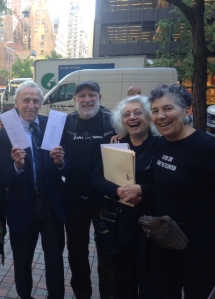
Jews Say No!  getting ready to deliver letters to Senators Schumer and Gillibrand

_ERD1575

DSC_0475W

DSC_0210W DSC_0496W

_ERD1570

_ERD1527

_ERD1547

      _ERD1468

DSC_0766W

We Tell Our Senators: STAND UP FOR PALESTINE

October 7, 2014

October 6, 2014

Press Release

CONSTITUENTS OPPOSE NEW YORK SENATORS’ SUPPORT FOR

ISRAEL’S ONGOING HUMAN RIGHTS VIOLATIONS

Protest in Front of Their Offices to Last Eight Hours

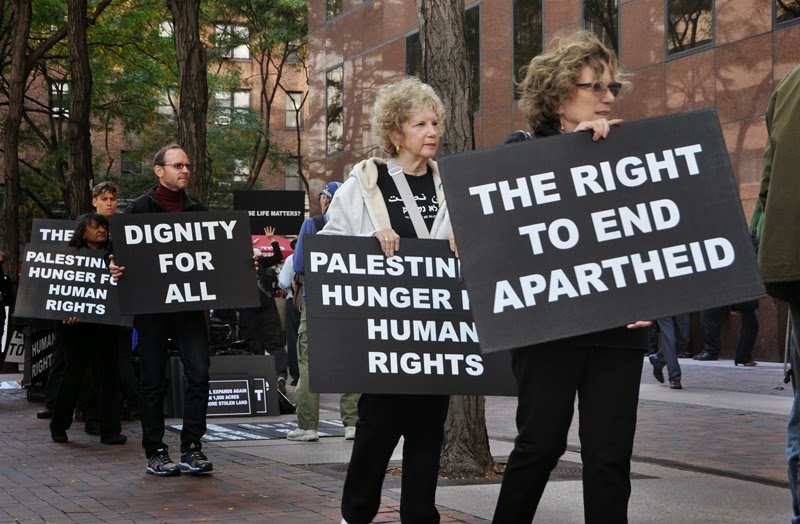
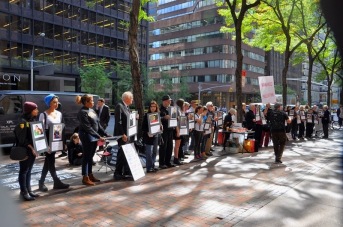
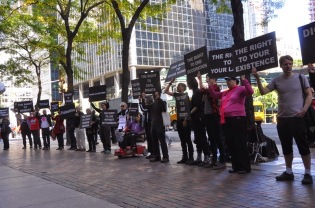
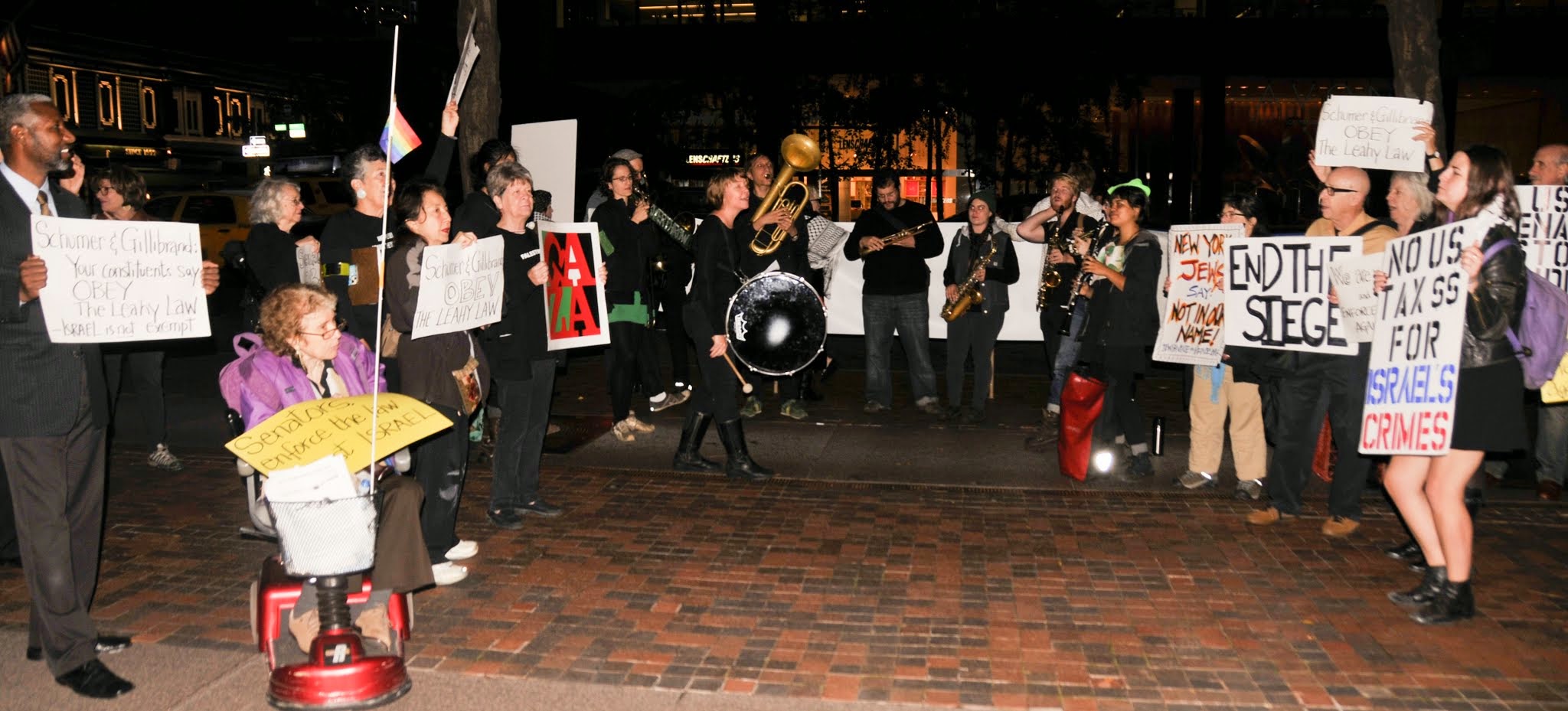
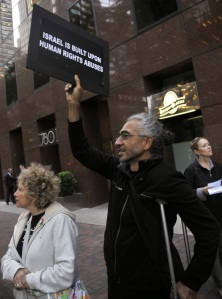
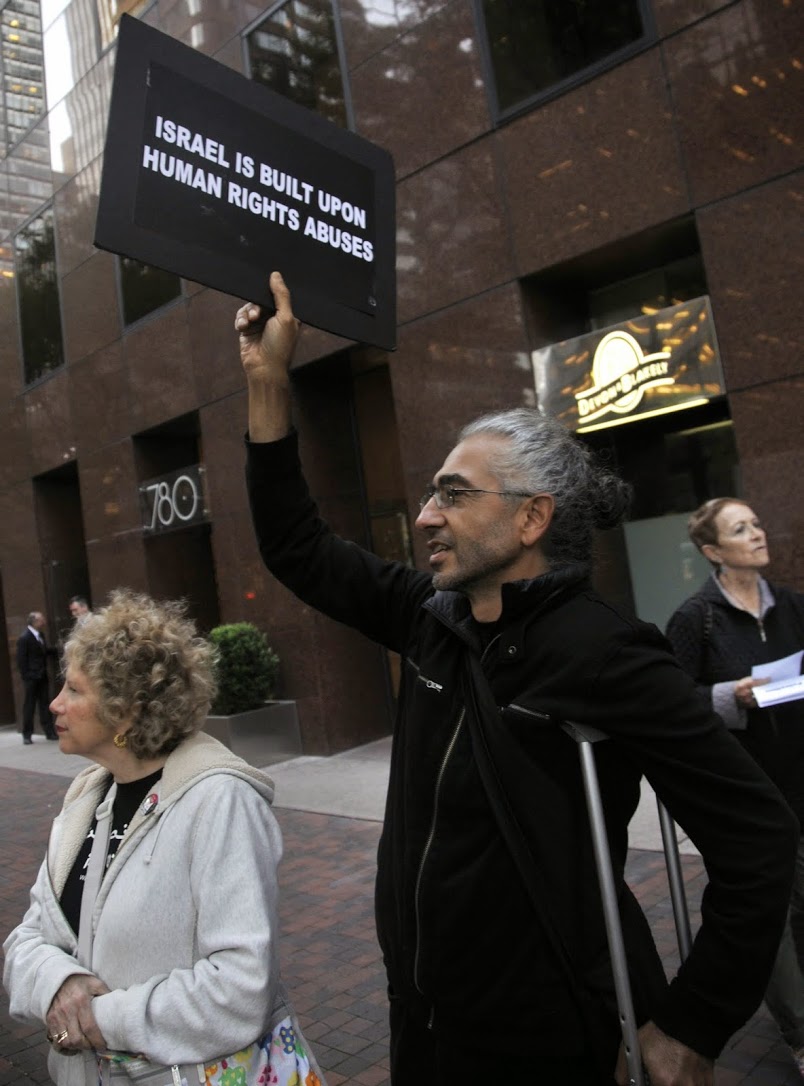
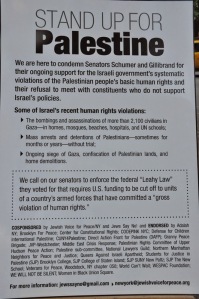
 New York City  Today, a coalition of more than twenty community groups will stand from 11 a.m. to 7 p.m. in front of the New York City offices of Senators Charles Schumer and Kirsten Gillibrand (780 Third Avenue) to protest their ongoing support for the Israeli government’s systematic violations of the Palestinian people’s basic human rights and their refusal to meet with constituents who do not support these policies. (See letter being delivered to the Senators this morning http://mondoweiss.net/2014/10/ny-senators-letter)

“Senator Schumer has repeatedly supported Israeli government aggression against the Palestinian people, including the latest assault on the Palestinians of Gaza,” said Candace Graff from Jewish Voice for Peace-NY, one of the co-sponsors of the day’s protest. “And both senators have failed to seek enforcement of laws requiring U.S. funding to be cut off to units of a country’s armed forces that have committed a ‘gross violation of human rights.’”  This law, known as the “Leahy Law,” applies to the Department of Defense and the State Department.

During Israel’s most recent assault on Gaza this summer, the Israeli military killed more than 2,100 Palestinians, at least 1,400 of them civilians, according to the UN, including 500 children. Human rights groups such as Amnesty International and Human Rights Watch have documented numerous instances in which Israeli forces violated the laws of war, employing disproportionate, reckless, and indiscriminate violence against the occupied and besieged population of Gaza, including attacks on hospitals, schools, and mosques, and the destruction of thousands of homes and civilian infrastructure. The coalition demands that both of New York’s senators hold Israel accountable to the letter and spirit of the Leahy Law, and support the holding of hearings to apply these laws to Israel, as to other human rights violators.

This protest is part of a broader movement gaining momentum worldwide. It is bringing together people from multiple communities who share a common commitment to justice and human rights. As articulated by Mohammad Hamad from The New School’s Students for Justice in Palestine, one of the day’s endorsing groups: “From Ferguson to Palestine, communities are joining one another to challenge oppressive structures and re-commit ourselves to stand for justice and against all manifestations of racism and bigotry.”

Today is a day to make these voices heard.

The day’s demonstration and events are co-sponsored by Jewish Voice for Peace/NY and Jews Say No! and endorsed by Adalah NYBrooklyn ForPeaceCenter for Constitutional RightsCODEPINK NYC; CUNY4Palestine; Defense for Children InternationalPalestine; ; Direct Action Front for Palestine (DAFP); Granny Peace Brigade; JVP-Westchester; Middle East Crisis ResponsePalestinian Rights Committee of Upper Hudson PeaceActionPalestine sub-committee, NationalLawyers Guild; Northern Manhattan Neighbors for Peace and Justice; Queers Against Israeli Apartheid; Students for Justice in Palestine (SJP) Brooklyn CollegeSJP College of Staten Island; SJP SUNY New Paltz; SJP The New School; Veterans for Peace, Woodstock, NY chapter 058; World Can’t Wait; WESPAC FoundationWE WILL NOT BE SILENTWomen in Black Union Square.

Proudly presenting, JSN’s Dorothy Zellner, interviewed by Philip Weiss

June 25, 2014

Image

This summer marks the 50th anniversary of the Freedom Summer, the legendary effort by the civil rights movement to open up the vote in Mississippi to black people. That struggle is the subject of Freedom Summer, a documentary that will air on PBS’s American Experience, tonight. One subject of the film is Dorothy Zellner, a former staff member for the Student Non-Violent Coordinating Committee, who is today active in the Palestinian solidarity movement as a member of the board of the Friends of Jenin Freedom Theatre, a founding member of Jews Say No, and a volunteer for Jewish Voice for Peace.

A few weeks ago during a commemoration of our visits to Gaza five years ago, Zellner told me “We are winning.” I asked her for an interview. She agreed, and the Q-and-A below reflects two conversations, with some edits. 

Question: You’ve said on a couple of occasions, We’re winning, we’re turning the corner. What is happening, why do you say that?

Dorothy Zellner: Well this is not an original thought. When I express this idea in meetings with other activists, people nod and agree. I’m very well known as a pessimist. That’s why when I said it people actually paid some attention.

OK but why do you believe that?

There are a few reasons. First of all, BDS [Boycott Divestment Sanctions] is turning out to be very very strong, and obviously successful, more successful than we even thought. A couple of years ago Donna Nevel and I wrote a piece in Jewish Currents, responding to an Australian Zionist. He was very dismissive. He said BDS has changed nothing, it hasn’t altered the Israeli economy, no one cares. Now a year and a half later it is so obvious that BDS is growing by leaps and bounds especially on the economic level, the divestment level.  Yesterday you know the Gates Foundation announced that it was divesting from G4S. That’s only the latest development.

It’s not only in dollars and cents, but in the consciousness. The consciousness about BDS is totally different from two years ago. It’s now considered to be a serious way for people to register their feelings about the occupation. No one is dismissing it.

Number two, what’s going on in the campuses is truly amazing to me. I think I realized that we were going to win when the first Open Hillel was created on campus [at Swarthmore last December]. Because this is a sea change: the Israeli government policy is built on relying on the Jews in the Diaspora to be either completely convinced of the efficacy of the Jewish state or else bludgeoned into supporting the Jewish state as it exists now. The Open Hillel means they can’t count on the Diaspora any more.

This seems like a small thing– oh, it’s just three campuses. But I can tell you that having done this work for years now, trying to change the conversation inside the Jewish community, that what these students did this was earthshaking because it means that they want to think. They don’t want anyone else to think for them anymore, and they know about the abuse they will get, and they are willing to take the abuse, it’s not going to come as a shock to them. They were immediately excoriated by the head of the Hillel, but it doesn’t seem to have fazed them. They are not saying they are necessarily becoming anti-Zionist, but that they want to be able to think in a Jewish environment. And I know by now, from being at this for 12 years– by the way a small amount of time, others have been involved much longer—that this is very telling. And if these students want to think and they want to be open to what is really happening there, we have the facts. They will see the facts, they will believe them, they will understand them.

You know, I have yet to meet one single human being who has been to Israel and Palestine, who has not had their entire life changed, and they can call you all kinds of names, anti-Semite and self-hating Jews. But we have actually seen the Israeli policies and in some cases we have been the victims of them. We have seen Palestinians herded like cattle through these institutionalized checkpoints, that are like mini prisons.

I am totally confident that people understanding the facts will change their behavior.

A third factor I think is extremely important: there has been interest on the part of black intellectuals. I know that several trips to the West Bank (you can’t go to Gaza) have taken place with leading black intellectuals who have decided to make common cause with this issue. People like Vincent Harding [a prominent black leader who died recently]. They have seen what is going on there, and they speak with a kind of moral authority that is  unimpeachable. It’s like Archbishop Tutu– when he goes to the West Bank and he looks around at what’s happening and says, This is worse than apartheid, well he speaks with the kind of moral leadership that no one can dispute.

I know in the Zionist circles, they speak of Tutu as an anti-Semite. But it’s getting harder and harder to get away with that. They can call a nebbish like me an anti-Semite. But even trying to call Vincent Harding an anti-Semite– this is not going anywhere, people are not going to accept it.

The fourth factor is the collapse of the negotiations, and the US uttering a word of criticism of the Israelis for their role.

Things are happening that we couldn’t possibly have predicted. And we are now in a phase where the momentum is on our side. And it all makes me feel that we have turned the corner.

When you say we are winning, define those words.

By we, I mean the movement to end the occupation, although sometimes I mean the Jewish community. Winning means that we will get the occupation ended, but what form or shape that’s going to take I don’t know.

So will things go more easily now?

No. The caveat is that turning the corner doesn’t meant this is going to be easy. The next few years are going to be harder for us, because we are winning. The attacks on us are going to be worse. This is like a cornered animal: its fangs are out now. You can see this happening already. I am told that big institutions in Israel are now bringing African Americans over there by the busload. I’m assuming that’s because of the important African-American intellectuals, they want to counter it.

Or did you hear about the New York city council having a secret panel discussion about strengthening economic ties with Israel ? I take that to mean BDS is hurting the Israeli powers that be, and they are looking for new and other ways to overcome the economic loss.

Does this mean you thought we weren’t going to win a few years back?

No. But I was thinking of it in terms of decades. And when you have a win that’s so far in the future, you don’t dwell on that because it will just make you depressed. Now something qualitatively different has happened. And if I as a lowly person on the ground can feel it, the right wing can feel it too. I don’t know what forms of backlash it will take. I expect public abuse in the Jewish community. Though it’s already at a hysterical high. I have rarely seen people who are supposedly normal go from 0 to 60 in a second and become hysterical maniacs. That’s what happens with this issue and it’s going to increase.

Have you experienced that abuse in other political activism?

I’ve been in two big struggles in my life. The civil rights movement, and this. The women’s movement, the antiwar movement, of course I was involved. But these have been my big engagements. When I was in the south in the 60s, the white people didn’t really curse you out, they just tried to kill you. And this abuse is nothing compared to that.

On the other hand, I have not seen this level of hysteria before. I haven’t. Ever since I got involved 12 years ago, it has been increasing. And it hasn’t leveled off. Even some of the attack dogs are being attacked. Did you see them going after Dershowitz? It’s very unusual for him, to get some of his medicine back. He was bitten and he was kind of shocked.

Who will the backlash target?

I’m guessing there may be more social pressure put on people who are vulnerable. You’re not vulnerable, I’m not. But there are people who are wending their way through the Jewish institutional community who are vulnerable to pressure.

I want to tell you about exceptions to this. Howard Horowitz—he’s organizing in synagogues in Westchester, he’s bringing amazing Palestinian people to speak. That’s something we haven’t achieved here in the city. Or Kathleen Peratis, she was on the board of J Street, she wrote an article reconsidering BDS. This goes to my theory that we’re turning the corner. These things were not happening a couple of years ago. I think they are going to happen at the same time as the counterattack. And it’s good to know about the backlash, because if you’re prepared for it, you can get through it.

Remember, it’s not because of our failure that we’re being attacked, but because of our success. And we can work through this period. We are going to keep going because we understand what the ultimate goal will be.

You know that I have often said, Let’s write off the Jewish community, they’re reactionary. Have you had that response, emotionally—let’s wash our hands of the Jewish community?

I can’t say I haven’t had my moments of being discouraged. But no, I haven’t written them off. If I had written them off, why would I be standing out there on 96th St. with Jews Say No?

So why did you hang in there?

I think this goes back to my history. I was a past staff member of SNCC [Student Nonviolent Coordinating Committee] for five years, 1962 to 1967, and I was in Mississippi for the Freedom Summer of 1964.

And you’re in a film that’s going to be aired on American Experience, June 24?

Yes. “Freedom Summer,” by Stanley Nelson. We were in SNCC, we were in a black-led organization, a black-led movement. But this is my point: What SNCC needed– what they wanted– was for the whites to go and work in the white community. And the reason for this was, one, of course they would get allies. Even though people were very realistic about this; these allies weren’t apples hanging off the tree, ready to be plucked. It was hard work in the south. But the second reason was to neutralize the white community, if we failed to get allies. And there were many hardy souls who attempted to do this with little or no success. The reason for this was the extreme danger in the white community and the extreme hostility. White people who opposed segregation publicly were shut down or arrested or threatened and so forth.

And since then, in the back of my mind, I have always felt that this was something we needed to do that we didn’t do…. White students in the Southern Student Organizing Committee worked alongside SNCC, trying to establish a beachhead in the white community and build these kinds of coalitions. Because a lot of us felt that were it not for racism, there would have been natural coalitions between black and white working class people. But most of these efforts in U.S. history have failed– from populism on. That doesn’t mean they will always fail, but racism has been used very effectively. That’s a shibboleth of American political science.

But politically speaking, we couldn’t do what a lot of black people thought was a mandate: to go work where people really needed to be talked to.

Well along comes 2002, and for various reasons I got involved with this movement, and I realized, This is my moment. This is what SNCC told me to do 50 years ago. And now I have the chance.

Wow. That’s a great story.

But to answer your question: I’ve never given up on the Jewish community. Even though I don’t like being abused. Some people, actually the really great people—Donna Nevel, she’s not fazed. But I don’t like it.

What do you say when you’re trying to explain the situation to people? Is there an anecdote, a particular incident, or an observation you relate?

The incident that to me typifies my emotional reaction occurred on my first trip in the winter of 2002-2003 several months after the horrible Israeli invasion in the second intifada. I was in the Deheisheh refugee camp in front of the Ibda’a House and I was talking to people and right across the way I could see the wall, the barbed wire on the wall, and the guard tower on top of the wall, and all these images flooded back to me from World War II, and I thought of my father, how relieved I was that he was dead and didn’t have to see this because flying over the guard tower was the flag with the Jewish star on it, and I completely broke down. I just sobbed, and during that trip I cried every day. My traveling companions were so annoyed with me, I was over the top. But I don’t have to explain to you the significance of those images.

You were on the left. How come you didn’t know about the occupation?

First of all the wall was just being built when I was there. Second of all I had spent many years in denial, avoiding this issue, but there I was and I was seeing it for myself. That was one of those life moments.

How many times have you been there?

Ten times since 2002.

Oh my god.

What can I say? One year I went three times. The last time was a year and a half ago, in March 2013. So I do feel like I speak with some experience. I have been all over Israel as well as the West Bank, and Gaza twice.

Tell me about the abuse.

Standing there on 96th St with Jews Say No is a really interesting experience. We stand there with signs, and this is a neighborhood that is heavily Jewish, and we give out leaflets, but we usually try not to engage with opponents, because there’s no point in the screaming matches. What happens– and here I’m trying not to cater to my native pessimism– is that for every person who has a thumbs up going by there are two thumbs down. The thumbs up are interesting. This is what they say. ‘How great that you’re out here, how brave you are.’ This gets on my nerves. I say, ‘We’re not so brave, we’re standing here on the street, come and join us.’ ‘Oh no, I can’t, but it’s really great that you’re doing this.’ And other people say,  ‘You’re absolutely right. You’re right.’ These are people who wouldn’t have said that five years ago. We get a surprising amount of support.

But the abuse is really ugly. Most of the time it’s not reasoned. ‘I’m horrified you’re here, you ugly bitch.’ Or it’s that two-word sentence that substitutes for a political conversation: fuck you, fuck you, and fuck you. Or, ‘you’re an anti-Semite. So it has now boiled down to personal epithets or “You’re an anti-semite.” Pure hysteria, people who are screaming and turning red.

Do you keep your cool or do you get into fights?

Well actually personally speaking, I don’t think I am very effective. I am there all the time. But do I like being there? As I told you, I don’t think I like being there. I tend to get very snappy and lose my temper. I don’t know how effective I am. That’s why I’ve learned it’s better for me not to respond at all. I will stand there and be stoic as people scream and froth at the mouth.

Well you know that about yourself, that’s good.

I’m 76, after all! I am a more effective speaker in a regular format, because I am relating everything to what I experienced in the civil rights movement. To me when people ask about the future, to me, it’s a no brainer. I can tell them that ethnic superiority doesn’t work.

I don’t know how long I could stand out there.

I have not given up, and I actually want to do more things we haven’t been able to do. There are 24 hour Jewish cable networks. Well, I want to get on there. I want to challenge them: if you’re so convinced you’re right, why don’t you have us on, and we’ll talk. Jews Say No has worked to have panel discussions in various places. We have had people from the liberal Jewish community engage us. Because that’s our self appointed mandate: we want to work in the Jewish community.

And it’s changing?

Yes, I think so. I say it’s worth it to get the abuse, because somewhere in Pennsylvania some kid on campus is saying, ‘I want to read this book. What is Zionism? What is going on in Israel? I don’t want to say I love Israel, I want to know what’s going on.’ And as far as the established Jewish organizations are concerned, this is the beginning of the end of the hand on our throats preventing us from talking or thinking.

You’ve seen the change personally?

Years ago, I was on a panel in a synagogue, and the attacks were so severe that I thought they were going to have to call the police. Today, there would be incredible hysteria and screaming, but you’d also have more people listening.

Why did you think they should bring the police?

A woman in the audience came up after it was over and she said in the synagogue—look, I am 100 percent atheist, but I respect a religious building—well this woman said to my debate partner, a young Israeli, “You’re a piece of shit.” Inside a synagogue!  I’m not proud of myself, but I lost it. I instantly became a 12 year old. And she started screaming, and the security people were hovering there. I thought she was going to attack my Israeli partner.

Do you say in the synagogue, I’m an anti-Zionist?

I didn’t define myself then and I often don’t now as an anti-Zionist or a non-Zionist. I define myself as a person who has spent her life working with civil rights and human rights, and I was being told by the government of Israel that they spoke for me, and I had actually seen with my own eyes the oppression of the Palestinians. And relying on Jewish tradition, I felt that I could not stand idly by. From that day to this, I have acted in that way.

I must tell you, I was seven years old when World War II ended. My father followed the war with a map, and pushpins in it. And you won’t know this name, but hearing Gabriel Heatter, a broadcaster, talking about where was the US army and more important, where was the Red Army.

What was the lesson?

The lesson was horrible things happen when people stand around watching and no one does anything. That is what impelled me into the civil rights movement. And later I realized it came out of a very important part of a Jewish social justice tradition, which I had obviously imbibed in my leftwing family,  even though they were not religious. I didn’t understand this for years, but for me, it all comes down to that saying about Hillel, who was asked to summarize Jewish teaching when standing on one leg?. “Do unto others as you would have them do to you. All the rest is commentary.”  That’s it to me. Thou shall not stand idly by.

I spent years in the South. I was shot at once, I was arrested. And now it was much closer to home. Israel claims it is speaking and acting for me. I say, Oh no no no, this is not tolerable.

What do you mean, you didn’t know for years this was your tradition?

I didn’t understand for many years, that this was part of my motivation. I grew up in a nonobservant home. Then later on as I did some reading about this– it is to me an inescapable fact that this is part of Jewish culture. It’s in the Jewish religion too. But in the Jewish culture, there was– whether it’s there today I really can’t say– but up until I was in high school and as an adult, that tradition was there. There is really no way of accounting for the overrepresented numbers of Jews in some of these fights. I understand it not to mean that we’re better, but because it is our tradition: we were slaves in Egypt, we were victims, we learned the hard way what happens when you stand around doing nothing. At least half of the lawyers who went south during the civil rights movement were Jewish. At least half of the Americans who went to Spain to fight were Jewish. That comes out of a deeply held social justice movement.

What do you say to those who would say, Ok, that was one Jewish tradition, but it’s been replaced by another, Zionism and American neoliberalism?

I would explain what has happened as nationalism. And that nationalism is killing us. When you have a national state that is really an ethnic state, it’s not really surprising that you have a Jewish community that is so retrogressive on the question. But I can turn that around: Look at the large number of Jews in the anti occupation movement. These are people who have been told since babyhood, that Israel is everything. I’ve seen synagogues where five-year old children just learning to write make signs saying “I love Israel” and these signs are all over on the walls.

To me, speaking as an atheist Jew, they have hijacked our Jewishness, and they have made it into a place, a country—so our Jewishness became a place. And the miracle of this is that so many people who were brought up like that, began to see with their own eyes. Who would have thought that Jewish Voice for Peace would have 140,000 people on their list. That’s a fifth factor in terms of turning the corner. I remember in the 1980s after Lebanon there was a group called the New Jewish Agenda. I wasn’t really involved with that. But I know they could be critical of Israel.

Well then the first gulf war started and SCUDS were fired at Tel Aviv, that’s when the New Jewish Agenda organization collapsed. That’s my version; that’s how I remember it.

But what it tells me is there are 140,000 people on the JVP list who are not going to be taken by surprise. They have gone there and seen this. They are willing to fight it. They will take the bumps and bruises that go along with that.

But I could say from your story that if there was violent Palestinian resistance to occupation, the JVP list would collapse.

No. I think a lot of people are on board now who understand the situation much better than they did then. They would not go under. They would not go under. Thousands of us have been there. You walk away saying what if I lived here and I would have to go thru that? Is it such a big reach to say, I would want to kill someone? Of course not. We oppose that but it’s not a reach. We are much more sophisticated now.

What if I said to you that your attitude about Jewish cultural tradition of social justice, one I agree with — that we’re romantics about Jewish life?

In one of the books I was interviewed in, that question came up. I said, maybe I was a romantic, but what’s wrong with that?

What was the book?

Going South:  Jewish Women in the Civil Rights Movement by Debra Schultz.  When I grew up, the great heroes of my teenage life were the Jews in the Warsaw Ghetto, and I used to– as a young teenager, I imagined what would happen if the Nazis were marching up Second Avenue? Would I go on the roof and be a sniper? Well that’s romantic. But I thought, What’s wrong with that?

But if you’re challenging me on this social justice tradition, and saying that’s just romanticism, you’re exaggerating it, I say no, I’m not exaggerating it. It was real. I don’t feel that’s romantic.

Isn’t it a form of Jewish exceptionalism?

No. I’m not saying we’re so special. Other people are too. If the Irish told me about their tradition, I’d be interested. I’m saying this was part of us. And this country that claims to be speaking for all of us in the world– they have abandoned that part of the tradition. I know you have felt funny about this; I don’t know how to convince you. But that tradition in Jewish life is there, and it is being violated. And this is why people are so hysterical. Because they know on some level, this is a big No No! You’re not supposed to oppress people, you’re not supposed to remove them from where they live. That happened to us.

But again, what if I say that Jewish life has been captured by Zionism?

That’s not the Jewishness I know. The Jewish establishment of course was captured decades ago. But there is this struggle on the ground. If you said, JVP has 2000 people, then maybe it would be hopeless, and you could say the community is totally corrupted. But there are 140,000. We’re winning, and I’m a pessimist!

I want to tell you something. I went to a social justice conference at the University of Illinois this spring. I told the story about SNCC, sitting up there with other SNCC people. We (white people) couldn’t do it, I said. We couldn’t organize in the white community. But now 40 years later it’s all coming together for me, I’m a Jewish activist organizing against the Israeli occupation of Palestine. Much to my surprise the whole audience burst into applause. It was a very nice moment. I can’t tell you how much support I got from old SNCC people.

That’s a beautiful story. When you said that you don’t identify as anti-Zionist or non Zionist, does that mean you try to honor the meaning that Zionism had in the Jewish community once?

I am an anti-Zionist. But I don’t define myself that way because I think it makes people unable to think. And if I was trying to have a real conversation with some of these passersby, sooner or later I would say that. But only when I was sure that they could hear what I say. But I am a critic of Zionism. The more I read about it the more critical I am of it.

Should Israel exist—does it have a right to exist as Jewish state?

My answer is I do not think that states that privilege one group over another are viable states. And this comes from my intensive schooling as a civil rights activist. I could not– 50 years ago, I could not work to make sure that black people in Mississippi had the right to vote and then turn around and be supportive of a state where every citizen does not have equal rights before the law.

Can you imagine a situation in which you are cheering a 2 state solution?

These are not positions taken by any organization I’m in but personally I don’t think the two state solution is possible any longer. But I want to follow what the people who live there want to do. That’s why I think it’s pointless to end up in these conversations, because many solutions have been floated and we can’t sort them all out. But our job is to get the US government to promote a decent policy and, believe me, that’s going to take everything we’ve got.

Is that a lesson from the civil rights movement?   

Well one big thing I learned is, you can’t predict what will happen. The week before the sit-ins started on February 1, 1960, if you had asked people whether in a week, a huge movement was about to start, people would have looked at you like you were nuts. These things had been brewing a long time, but nobody predicted it, and even when it happened, no one predicted it would spread like wildfire. Within weeks there were 100s and 100s of students in every southern state sitting in and demonstrating, and thousands and thousands of local people participating. All over the south.

White people too?

In the south there were very few white people. But in the north, yes. This is what boosted SDS. And when I speak about the civil rights movement, I say, you can’t replicate these things, but if it happened once it can happen again. In the US we have had big big mass movements, and what’s going to happen in the future one cannot predict. We have to keep plugging along, and realize that it’s the struggle that counts. You have to be willing to struggle.

In the anti-occupation movement I think we have turned a corner, despite the kidnappings and what’s happening in Iraq. The opposition will get much worse but we are going to win. And we have to have the kind of understanding that there will be no instant gratification but whatever you do now will have an effect on the future. That’s the lesson of the civil rights movement. All the earlier struggles, the Montgomery bus movement, the Brown v Board of Education decision led up to it. And what we see in the history books is a pallid imitation of what it was really like.

Palestinians are demonized as terrorists. Mandela was deemed a terrorist for a while. Was there similar demonization of black people in the south?

You can see in the movie on Tuesday, Freedom Summer, when three of our guys were kidnapped and killed in Mississippi, they interviewed white people in the community, who said it’s a fraud, it’s a fake, they’ve done this for sympathy, I don’t believe it.  It was total demonization. Total. And in those days, and right up to the present, white people are never called terrorists. Never. So black people were totally demonized.

Do you have an elevator speech, 15-30 seconds, on the conflict?

I always identify myself as a Jewish person and I say I’ve been there and I’ve seen it. I try to get through the hysteria, that this is nothing that someone told me, I’ve actually seen it. It often doesn’t work. As I said, in a longer scenario, I’m much better. Few of us is able to say anything coherent in these onslaughts people put us through. You’re standing there and someone is screaming in your face.

Make it concrete for me.

We had a sign up saying, End the occupation, and someone came up and said, “I don’t respect you, I don’t respect you.’ I said, ‘Let’s have a conversation, stop screaming and we’ll talk.’ She said, ‘You should be out there talking about our boys.’ All you have to say is “our boys,” and that’s the end of any argument. My response was “bye bye.” That infuriated her.

But I believe people go home and no matter what we say or what they say, they have a picture in their minds of some Jews who don’t agree with Israel. Somewhere along the line, someone will remember, we were out there, and we refused to go along.  Maybe we will have planted a seed and someone will realize we are right.  That gives me intense satisfaction. I look in the mirror and say you did a mitzvah today.

You were good Jews in this horrible moment in history?

We acted like mensches. We were human beings, and we refused to be stampeded by so-called group loyalty or blindness to Israel. We acted the way people should have acted toward us.

But is this about congratulating ourselves or about changing the conflict?

It is politically effective. I wouldn’t do it if I didn’t think it was. But I feel that we’re acting the way Jews are supposed to act.

How does your family feel about your work?

I’m from a non-Zionist family. I haven’t had to go through what a lot of people have had to go through. Nobody in my family is out there with me, but there’s some sympathy for what I’m doing, there’s no hostility.

So it’s not like you don’t talk to someone in your family over this issue?

I talk to everyone in my family. We have different points of view about it. I was lucky when I went to the civil rights movement, my family didn’t hold me back. My father supported me emotionally. There were many people whose parents were completely frantic and opposed to what we did, and tried to interfere physically with their own children’s work—and a lot of times for understandable reasons, the parents were afraid their kids were going to be killed. I’m fortunate, I didn’t have that problem. And now I hear all kinds of terrible stories, about people not talking to each other at seders; I don’t have that problem.

http://mondoweiss.net/2014/06/mississippi-reflects-struggle.html to read the wonderful comments. Get Mondoweiss delivered directly to your inbox every morning and stay up to date with independent coverage of events in the Middle East!