Archive for the ‘articles’ Category

Conversation – Phil Weiss and Dorothy Zellner

January 6, 2016

Palestinian citizens of Israel hold the key — Zellner

by Philip Weiss  Phil Weiss

Dorothy Zellner is a wise friend; I check in on her every once in a while to ask how she thinks the movement for Palestinian freedom is going in the United States. A founding member of Jews Say No! and a volunteer with Jewish Voice for Peace, Zellner has a substantial track record as an activist. She is a former civil rights worker who went south first in 1960, then spent 10 years working for civil rights organizations. I called her right at new year’s to ask her some questions.

PW: Dorothy, you were in the civil rights movement, and in the women’s movement. You’ve seen social change move from the margins to the mainstream. Do you see that happening now with the Israel/Palestine question?

DZ: I say mostly yes. If you think about the situation in Israel/Palestine even 5, or 6, or 8 years ago, we were really a little tiny tree in the big forest. Now I think we’re closer to the mainstream. I don’t have any documentary evidence for that. I just feel it. You don’t have to explain so many things so many times to people. They know some of the words, they know some of the language. I think we’re closer. I’m finding that if I say that I’m working on Israel/Palestine issues, and the occupation, people don’t look at me like I’m speaking Urdu. They actually understand the words. Now whether they agree is another story.

But being in the mainstream doesn’t mean you’re victorious, it just means that more people know about the situation. And I think more people do. That’s probably due to the incredible growth of organizations like JVP. So we’re closer. But are we there? No. I think we have been overtaken unfortunately by this terrorism craze. That’s probably going to be the case for the next while.

As long as there are these big terrorism episodes, it’s to everyone’s advantage to go with that and forget everything else. It happened not only with Israel/Palestine, but you can even see how the Times played very little attention to the French climate change conference. It was all about Paris. Then it was California day and night.

Probably Netanyahu is going to do his best to try to fold the Palestinians into the general terrorism concern, and I think it’s very important for us to be on our toes about what terrorism is and what terrorism isn’t. Terrorism as I understand it means that extreme violence is perpetrated against civilian populations for a political purpose. By that definition, I don’t believe that the Palestinian movement is a terrorist movement. I don’t care how many 12-year-olds pull knives, that doesn’t make it terrorism. Terrorism is not just the technique; it’s the purpose, it’s the reason. So we have to be very straight in our heads about what’s a terrorist. If we’re not, then everybody becomes a terrorist. And if everybody becomes a terrorist, then nobody is a terrorist.

I think the term “terrorism” still is useful, and our own history as a left movement in this country is that we are staunchly opposed to terrorism. We are trying to unite people and move them forward, not trying to frighten people into the arms of anyone (most likely, the far right). I don’t know how many white people were scalped by Native Americans, you could portray Native Americans as terrorists, but they were fighting for their liberation. And Palestinians are fighting for their liberation.

But Dylann Roof is a terrorist. When he kills 9 black people, he has a political purpose. He thinks he’s organizing white people to oppose the advances of black people by scaring black people. We have to get this straight in our minds. Otherwise we become vulnerable when people say that Palestinians are terrorists– and they’re not. Even when they’re firing the rockets. Politically I don’t think this is a feasible tactic, but I don’t think that’s a case of terrorism. Because they are fighting for their liberation. And that’s different from trying to scare people into doing what you want.

Do changes in the conversation remind you of shifts during civil rights days? Is there a year in the 60s this recalls? The other day Israel’s ministry of education banned a book that portrays a Palestinian man and a Jewish woman having a romance, because it threatens Jewish identity. Can you say what this reminds you of in American history?

I don’t go back to the 60’s for a plan. This is such a deeply racist country that those in power have tried to keep the condition of black people off the stage, in the wings. What happened in the civil rights movement is that SNCC and others invented ways of cutting through media and getting themselves right under your eyeballs. That was the great success of the movement. The tactics and the people who were involved immediately broke through the ordinary conversation. We haven’t been able to do that in the Israel/Palestine movement. Yet.

So I’m not looking at this so much from a civil rights strategy. Rather, the analogy with the civil rights movement might be: what is going to happen in Israel proper, to the 20 percent of the population who are Palestinian citizens of Israel. No matter what happens to the occupation, there is still the question of what happens to those 20 percent.

The Zionists call this the Jewish state, but by any measure, it’s not a Jewish state even now. If you add the foreign nationals who live and work there, whose children were born there, and you add in the long-time Christians who live there also, who operate the churches there, and you add in the many thousands of non-Jewish spouses and relatives of Russians who emigrated to Israel, some people have estimated that it’s almost 30 percent of the population that is non-Jewish.

If you have a so-called Jewish state, and 20 percent are Palestinian citizens of Israel– everyone agrees, the left and the right, everyone agrees on that number– so Palestinian citizens of Israel hold the key and this is going to be interesting to watch what happens there. That’s where the analogy is to the U.S. Because black people in the U.S. from year one were never more than 12 percent.

A state that has 20 percent of its population being second class citizens is not a stable state. And sooner or later something will touch off that population, and it’s going to be extremely interesting to see how the government responds, regardless of what happens to the West Bank. That is one of the contradictions they’re dealing with.

There are other contradictions in Israel too that make it unstable. And that is the contradiction between the religious and the secular. That’s been going on since the state was founded. It’s already made a significant demographic shift inside the country. Jerusalem is now largely religious and Tel Aviv is largely secular.

The third is they’re having difficulty integrating, I use the word advisedly, integrating the Jews of color, like the Ethiopians. There are actually organizations in Israel dedicated to protecting the rights of Ethiopian Jews. So if everything was so hunky dory, how come this group has to have organizations protecting their rights?

In addition to the internal contradictions and the international isolation, what is emerging as a key factor is BDS (Boycott, Divestment and Sanctions). Nobody is scoffing at it anymore. When I was in France recently, I was shocked to learn that it is now illegal to promote BDS there. The issue has gone all the way up through the French courts, and the French courts have said it’s illegal to promote BDS, on grounds that it’s “incitement to hatred.” So the BDS forces are going to the European courts for a ruling, and they don’t know what will happen there, but in the meantime it’s a serious organizational issue, because if you stand in front of a store handing out leaflets you can get arrested and serve time and also be liable to fines. While I was there several groups were discussing this and one of them was the Jewish Union for Peace, which is similar to JVP, and a Jewish part of the anti-occupation movement. They had a long discussion about it, and they are going ahead regardless. This is important. This means that even the legal situation is not going to stop people. I’m sure the other organizations will not be stopped either. A state that is supposed to be for liberte, egalite and fraternite is going to arrest people giving out BDS literature! And those efforts are also being made in the United States. That doesn’t happen when you have a trivial technique. BDS is very important, and it’s growing.

We watch this closely because we’re anti-Zionist Jews. Isn’t it possible Israel is merely approaching a crisis, like the Civil War (!) that will “save the union,” in its case preserve a Jewish state? By contrast, the civil rights movement was nonviolent, largely. What chance do you see of a nonviolent resolution in I/P?

I am still of the belief, that what we are seeing is like the slow motion demolition of a building, it comes down very slowly. The Israel we know and have come to love [chuckle] is coming down.

Now they could have had a Jewish state if they had agreed to a two-state solution maybe 25 years ago. I don’t see that it’s possible now. I just don’t see any way that it’s possible.

The issue is going to be, and has been already– that it’s one state, and what kind of a state it’s going to be. That’s where the struggle is going to go. What kind of state will this be? I am very much in favor of people being safe. I want Jews to be safe in Israel/Palestine, whatever you call it. I want Palestinians to be safe. I want everyone to be safe. But it’s going to be hard to be a nonviolent change.

The Palestinians have been using nonviolent techniques at least since the 80s. The first intifada was largely nonviolent. Because it failed, the second intifada was much more violent. But we can see over the years the protesters—in Budrus, in Bil’in– how they are treated when they are nonviolent. I have seen that with my own eyes.

The world generally has not generated the support for this Palestinian nonviolent movement. And if the world doesn’t support nonviolence, I don’t see what their recourse is. If people here are really serious about nonviolence, they better start supporting people there who are nonviolent, who are out there every week being perfectly nonviolent and getting shot at and tear-gassed by the IDF. That would make a difference. Like J Street, if they want a Jewish state and they want to minimize the possibility of violence, then they had better hurry up and start supporting these Palestinians who are nonviolent.

A bright spot in the future may be the Palestinian citizens of Israel who may be able to constitute a very important force in the country electorally. The fact that there’s a Palestinian list was very very important. If they stay together and if they keep pressure on the Supreme Court, which is a totally weak-kneed jellyfish court, they will be able to use their influence inside the country in a nonviolent way. And again, if you’re really serious about nonviolence, you have to support them.

Israel is sitting on a hotbox. And Adalah in Israel, which is like our NAACP, is not kidding when they say they can show discriminatory 50 laws on the books. In addition, an explosion is building up about housing. Since 1948, Israel has built not one new Palestinian town. Meanwhile they have built hundreds of towns for Jews. Now where do Palestinians live in a state where nothing has been built for them, and when they try to build on their own houses, they are denied permits and their houses are destroyed? So what will happen? You don’t have to be a wizard to figure out that this is an extremely dangerous situation.

So I see Israel sitting on a hotbox of their own making even if there were no West Bank or Gaza.

I am deeply dismayed that the Jewish conversation about these issues is so backward. It’s the most reactionary community around. Am I being too pessimistic or hard on that community? What are the signs of the change among Jews?

You say you’re deeply dismayed by the Jewish conversation. I know that– this comes through in your postings. Sometimes I feel that you’re being a bit too pessimistic. I think you are hard on them, hard on us maybe I should say, but many times I have to say it’s merited. In this country we have a Jewish establishment that’s getting older and older, it’s completely ossified in its thinking, it does not understand what’s happen on the ground. To think seriously that criticism of Israel is anti-Semitic?! That’s totally self deluding. If they think that, they are setting up this firewall against anybody that has criticisms. And they will be the last to know that these changes are happening. Because they can’t see it, they’re in the bubble; and to protect themselves, they are becoming more vicious.

And the Jewish young people, we often don’t hear much from them in the Jewish press, because they’re leaving the established Jewish world. They’re slamming the door. I think that’s a big factor in the changes in the Jewish community. The old part is still very strong, ridiculously strong. But how long they will hold on, I don’t know.

You and three or four other wonderful civil-rights veteran Jews went on that Open Hillel tour of campuses last spring. These are people who should have been welcomed into every goddamn synagogue in the country to celebrate what they represent. They were shunned because of what they were saying about Israel. Who can save Israel if not these people? No one. It’s too late. That is my reflection. Can you reflect on the tour months later?

When we went on the Open Hillel tour, it wasn’t the synagogues that didn’t welcome us. What was worse–the campus Hillels didn’t welcome us. That’s worse. For these young people supposedly being taught in the United States of America that they should listen to various issues in order to make up their minds– 12 out of 13 Hillel’s wouldn’t welcome us.

But—we spoke at those 13 campuses. The Hillel’s didn’t welcome us but the other student groups rushed in to welcome us. And very many of those people were Jews. So this illustrates what I’m saying. The establishment leadership still thinks they still have things under control. And they intimidate the Hillel’s from inviting people like us. But they don’t realize that 20 to 30 percent of the membership of Students for Justice in Palestine (SJP) is Jewish. All over the country, the Hillel establishment is losing the kids, and those are the most vital, the most energetic, and the most thoughtful and critical kids. So the old-time Jewish establishment is hanging on to this institutional structure, like hanging on to a fish’s spine after you eat the fish.

If the established Jewish leadership has more rebellions like Open Hillel and they have more desertions, I suspect that what will happen is that the Jewish community leadership institutionally will get more and more vicious until they begin to see that the house of cards is falling down.

That’s what I’ve been feeling about the occupation: I don’t see that we’re going to lose this, how we can lose this? The Palestinians are going to win just by staying there. They practice “sumud,” the Arabic word for being “steadfast.” They’re going to win, because this is not a society that’s going to adapt to them under these conditions. The only way that Israel can adapt– the government of Israel can adapt– is by making this a multi-lingual multi-ethnic state, that’s the only way the pressure can be taken off.

But in order to prevent that from happening, since the Israeli government has the guns, the tanks, the airplanes– it looks to me like they could become more and more vicious and could use them.

On the street, I’m seeing more people with thumbs up, and more people who have always been opposed but who are more hateful in their responses. That seems to me to be a situation that’s going to go on for some time until there’s a tipping point, til people realize especially in Europe that they’re betting on the wrong horse.

What’s possibly analogous is the jockeying behind the scenes that occurred among the white rulers of South Africa when they realized that the end was near. There evidently were some white people who were smart enough to know that if they wanted to keep power, they had to give up some of their power. You could call them enlightened capitalists, whatever you want to call them. I think that’s starting to happen in Israel. We’re seeing the security apparatus openly criticizing Netanyahu, and who knows what else is going on that we don’t know anything about. They may be saying to themselves, this is the situation, it’s better to cope with reality. Better to do a, b, and c so that we keep a lot of what we have.

I do not see this state of affairs going on another 50 years, like it has in the past. This is not stable, this is not sustainable. The tide is definitely turning against the Israeli government.

Now it’s hard to see that on the ground; it’s hard when you go to these pro-Israel meetings and you see the same old hysteria. But if you look around, a lot of people at those meetings, in ten years are going to be dead. They’re in their 70’s and 80’s, and they’re clinging to some vision they had in 1948; and some of that vision was a good vision. I don’t want to take that away from them: the vision they had of being you know a phoenix coming out of the ashes and being a non-materialist society–which it actually was in the beginning. But they’re clinging on to that vision. And we know from what’s recently come out, a lot of people who fought for the Haganah, they were fighting because people told them it was kill or be killed. Many of them later came to realize: why did 700,000 Palestinians have to be removed, never to be permitted to come back, and all their goods stolen? Some people have had a crisis of conscience. And that’s why studying the Nakba is very important. And all the movies being made about that are very important. My favorite one is “The Great Book Robbery,” about all the books that were taken. Let’s not even talk about the houses, let’s talk about what’s was in the houses. Tom Segev says there was a warehouse in Tel Aviv with 50,000 rugs in it. And people just came and took whatever they wanted. Who did they think they were taking them from? This has to be dealt with.

And though it all looks permanent from the outside, it’s not. It’s totally impermanent. When the Palestinian citizens of Israel get organized, wow, we’re really going to be seeing something else.

Why We Must Challenge Islamophobia In All Its Forms

December 26, 2015


WBAI: NY Jews Condemn Islamophobia and Racism

December 11, 2015


 New York City 12/08/2015 by Linda Perry (WBAI News)

New York Jews are speaking out against Islamophobia and racism. “We will not be silenced about anti-Muslim and racist hate speech and hate crimes.”

Members of Jewish Voice for Peace and Jews Say No, gathered under the umbrella of Jews Against Islamophobia. They stood at Rockefeller Center Sunday night in the shape of a menorah, with nine signs representing each of the Chanukah candles, each symbolizing an injustice. They rekindled the commitment to speak out against all forms of hate speech and violence directed at the Muslim community or those perceived to be Muslim.

Please click on the arrow at the WBAI link to hear our report.

headline photo

Salon: “We will not be silent”: American Jews hit the streets during Hanukkah to fight Islamophobia and racism

December 11, 2015

Jewish Voice for Peace condemns “state-sanctioned Islamophobia & racism” and anti-refugee xenophobia this Hanukkah

This Hanukkah, Jews across the U.S. are taking to the street to rally against the Islamophobia and racism rampant in their communities. jvp-hannukah-protest-ny-620x412
 On each night in the eight-day-long religious holiday, Jewish activists are participating in protests against various forms of injustice in a campaign initiated by the Network Against Islamophobia, a project called for by national peace organization Jewish Voice for Peace (JVP) to challenge anti-Muslim bigotry, along with Jews Against Islamophobia, a coalition of JVP-New York and the activist group Jews Say No!

The demonstrations are being held in 15 cities throughout the country, including Chicago, Boston, Miami, Seattle, Atlanta. The first demonstration was held at New York City’s Rockefeller Center on Sunday, Dec. 6, the first night of Hanukkah.

Activists are conveying their commitments through signs in the shape of eight candles, which together comprise a symbolic menorah. A ninth sign, modeled after the shamash, or “helper” candle, reads “Jews against Islamophobia and racism — rekindling our commitment to justice.” The eight pledges listed on the other candles are:

  1. We will not be silent about anti-Muslim and racist hate speech and hate crimes;
  2. We condemn state surveillance of the Muslim, Arab, and South Asian communities;
  3. We challenge, through our words and actions, institutionalized racism and state-sanctioned anti-Black violence;
  4. We protest the use of Islamophobia and anti-Arab racism to justify Israel’s repressive policies against Palestinians;
  5. We fight anti-Muslim profiling and racial profiling in all its forms;
  6. We call for an end to racist policing #SayHerName #BlackLivesMatter;
  7. We stand against U.S. policies driven by the “war on terror” that demonize Islam and devalue, target, and kill Muslims; and
  8. We welcome Syrian refugees and stand strong for immigrants’ rights and refugee rights.

read more: http://bit.ly/1NkZwuy


A New Report Shows That the Palestinian Movement is Under Attack in the US

October 15, 2015

Alan Levine: Is boycott a bad word?

July 30, 2015

Is boycott a bad word?

Hillary Clinton recently wrote a letter to Haim Saban, billionaire owner of Univision and uncompromising supporter of Israel, seeking his advice about the Boycott, Divestment, and Sanctions  (BDS) movement. The movement, she says, seeks to “isolate” and “punish” Israel, and we “need to make countering BDS a priority.” However, her letter does not say what it is that BDS supporters want or believe; not a word about Israel’s human rights violations, an unlawful occupation, collective punishment or any of the other conditions of oppression that prompted Palestinians to initiate the BDS movement for Palestinian freedom and equality.

The inference is that the reasons for BDS do not matter. Boycotts themselves, she implies, are not a legitimate tool in the struggle to achieve human rights. Clinton of course, knows better.

So, too, should the oversight and Government reform Committee’s Subcommittee on National Security. On July 28 the Subcommittee held a lopsided anti-BDS hearing on the “Impact of the Boycott, Divestment, and Sanctions Movement.” Explanatory material for the hearing said nothing about BDS being a movement striving for freedom and equal rights.  No Palestinian or Palestinian-American leaders of the movement were there to testify. It was, in fact, very much like holding a hearing on Jim Crow and excluding African-American leaders.Boycott movements have an important and honorable place in our country’s – and the world’s – history of peaceful protest. In my lifetime, three great boycott movements have exposed and successfully alleviated conditions of injustice and oppression.

In the mid-1950s, the requirement in Montgomery, Alabama that black bus passengers surrender their seats to whites led to a year-long boycott of the city’s public buses. Desegregation of the buses followed. When I went to the south as a civil rights lawyer some 10 years later, those I worked with understood, as have historians since, that the movement for equality and justice in which they were then engaged had begun with the Montgomery bus boycott.

In the mid-60s, farmworkers organized a strike to protest the appalling working conditions in California’s grape-growing fields. Strike leaders appealed for support of a nationwide boycott of California table grapes.  Those who enlisted in what was known as “la causa” spoke not only of conditions in the fields, but hunger and poverty, discrimination against Mexican-Americans and Latinos, and the failure of labor laws to protect our most exploited workers.

At about the same time, opponents of the South African system of black oppression called apartheid began a campaign to persuade their supporters around the world to stop doing business with South Africa. Over the next 20-plus years, anti-apartheid activists organized an economic, cultural, and sports boycott of South Africa that the world came to understand as one of the 20th century’s signature battles for democratic rights.

What unites these great boycott movements is that each spoke with moral clarity on fundamental issues of equality and justice, and each grew out of an understanding that recourse to the ordinary mechanisms of government was unavailable. In my view, BDS is properly understood as a successor to those boycott movements.

The moral clarity of the BDS movement is hardly contestable. The enormous economic, physical, and emotional toll on the Palestinians exacted by the occupation has been repeatedly documented by every international agency that speaks to the issue. Within Israel – that is within the Green Line – Israeli civil rights agencies themselves describe a dual system of government services and benefits that is uniformly inferior for Palestinians compared to Jewish Israelis. In neither respect is there any serious argument that Palestinians are not gravely mistreated.

Notably, Clinton makes no such argument in her letter to Saban, saying only that the comparison to South Africa is unfair. But she knows, among other things, that Palestinians are forcibly removed from land on which Israel says they may not live and that there are roads in occupied territory on which West Bank Palestinians may not drive. Many, including anti-apartheid activist Desmond Tutu and former President Jimmy Carter, recognize it as apartheid.

She also says that the vindication of Palestinian rights, including the creation of a Palestinian state, should be left to direct negotiations between Israel and the Palestinians. But if there ever was any doubt about the current Israeli government’s willingness to negotiate the terms of a Palestinian state, it was laid to rest by Prime Minister Netanyahu’s pre-election vow never to accept a Palestinian state.

Clinton knows that. But in her run for the presidency, it does not seem to matter. Her letter boasts of her record in beating back reports and resolutions that criticize Israel’s human rights violations. Yet there may be a price to pay. Within the Democratic Party, a November 2014 poll shows that the idea of unconditional support for Israel is eroding, particularly among young and African-American and Latino voters. And in recent days, another poll, this one of the Democratic Party’s “opinion elite,” shows growing criticism of Israeli policy towards the Palestinians.

Even if there is no hope for Clinton, the growing grassroots opposition to Israel’s policies reflected in these polls is an encouraging sign. As we have learned from the boycott movements that preceded BDS, it is grassroots support that ultimately drives the success of every movement for freedom and equal rights.

Levine is a New York City civil rights lawyer who has represented social justice activists throughout his career.

Alan Levine Letter to the Editor – NY Times – published May 8

May 8, 2015

To the Editor:

Pamela Geller is an Islamophobe whose public remarks about Muslims have rightly been condemned by the Southern Poverty Law Center as hate speech. But she has the last word in your article (“Organizer of Cartoon Contest Trumpets the Results,” news article, May 5), wrapping herself in the mantle of the First Amendment as if she had made a useful contribution to a public dialogue about Islam.

She has not. While hate speech is protected by the Constitution, the sole purpose of such speech is to inflame bigotry and to inflict injury. Your reference to the case of Debbie Almontaser is a case in point.

Ms. Almontaser, a respected educator and community leader, was selected by the New York City Department of Education to head the Khalil Gibran International Academy, the city’s first Arabic dual-language school. In the months after the announcement of the school’s creation, Ms. Geller and her allies unleashed a hate-filled barrage of false and Islamophobic accusations about Ms. Almontaser and the school.

Capitulating to the campaign, city officials forced her to resign. She then filed a complaint with the Equal Employment Opportunity Commission.

In ruling that Ms. Almontaser had been the victim of anti-Muslim prejudice, the commission said that the Department of Education had “succumbed to the very bias that creation of the school was intended to dispel and a small segment of the public succeeded in imposing its prejudices on D.O.E. as an employer.”

Ms. Almontaser’s reputation and career survived Ms. Geller’s onslaught. However, her ordeal should be a reminder that those who propagate hate speech are not proponents of First Amendment rights, but destroyers of lives.

ALAN LEVINE

New York

The writer is a civil rights lawyer who represented Ms. Almontaser in her suit against the Department of Education.

The Jewish establishment has banned these four valiant Jews. Why?

April 1, 2015

 Philip Weiss on Mondoweiss March 31, 2015 

33122987-7115-4018-b5d9-6c48c84b45e2


This is the story of a tragedy inside the Jewish community.

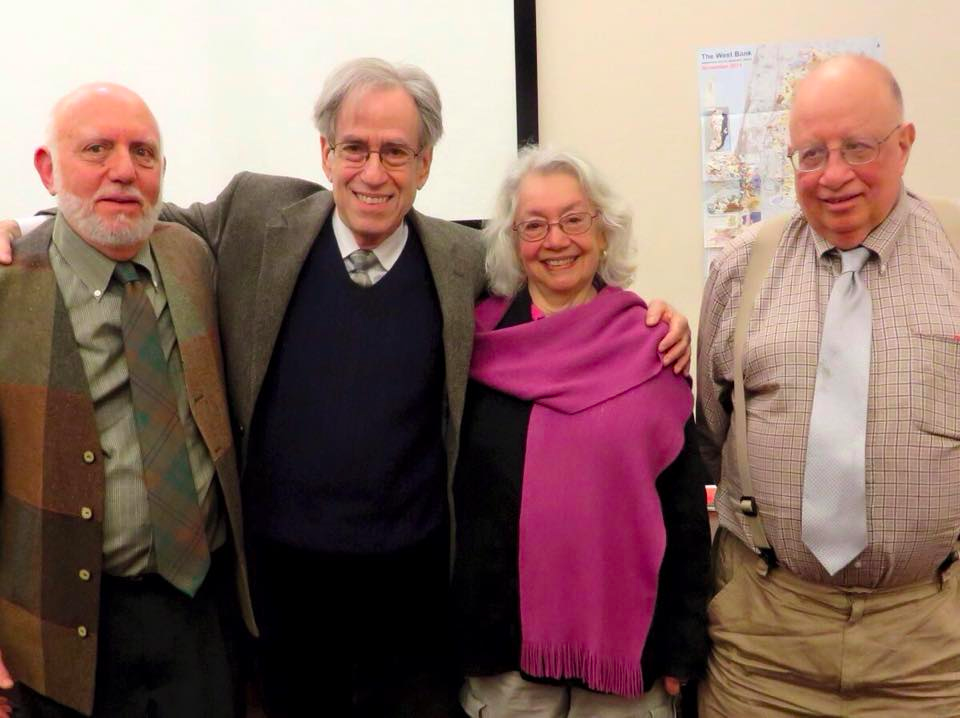
The four American Jews above are on a national campus tour. All in their 70s, they are veterans of the civil rights movement; they went south 50 years ago to help free our country from Jim Crow, risking their lives for equal rights.

But they have been banned from speaking at Hillel, the Jewish campus organization, because they have come out in favor of Palestinian human rights.

Last Wednesday they were to speak at Swarthmore Hillel, but the gangster who runs Hillel, former congressman Eric Fingerhut, hinted at legal action if the students dared to let them speak– so the students had to start a new Jewish group called Kehilah just to hear them.

Eric Fingerhut, the head of Hillel International. (Photo: Shahar Azran for Hillel)

The next night they spoke to an overflow crowd at Muhlenberg College, introduced by former Hillel president Caroline Dorn. Dorn had to quit Hillel in order to host them—and she also had to meet with the college provost even to get permission for the four to come on campus because the college administration was afraid of alienating Jewish students. “It was devastating,” she says. And last night they spoke to more than 100 at the University of Michigan. Again: barred from Hillel.

So these four travelers are freedom riders twice. First in their 20s in the civil rights movement, now in their 70s, sponsored by the Open Hillel movement.

“Why are they so afraid about what a bunch of old folks are going to say to you?” Mark Levy asked at Swarthmore.

Why? Because when I saw them at Swarthmore, three of them started to weep as they told their stories, even 50 years later. Why? Because they witnessed an American social revolution in which many people suffered, and they are extending that experience to Palestine.

Levy is the man on the left. A retired teacher in New York, he went south because he thought the best way to fight anti-semitism was to fight discrimination against all people.

Next to him is Larry Rubin. Rubin went south “automatically” from the Sholom Aleichem Club in Philadelphia 50 years ago because “I wanted to make my country better.” But in Belzoni Mississippi, a sheriff said to him, “We haven’t hanged us a Hebe in a long time” and the white people said he was trying to “destroy” the country. The same charge was hurled at him when he went to Palestine and witnessed the apartheid conditions there.

Next in line, Dorothy Zellner. Like Rubin, she worked for SNCC, the Student Non Violent Coordinating Committee. She went south because she believed Jews fought injustice in the garment industry, in the Spanish Civil war, in the Warsaw Ghetto, because the Talmud told them to:

“Who is honored? The one who honors all human beings.”

On Zellner’s left is the baby of the group, Ira Grupper. He grew up Orthodox in Brooklyn, and twice he broke down last week as he spoke. First when he said that he had named his daughter after his friend Vernon Dahmer, who was murdered in Mississippi for helping black people to vote. The second time when he told of his arrest with hundreds of other men at the Mississippi Fairgrounds, and every night as a form of humiliation and control the cops served the white prisoners their bologna sandwich and cup of milk first but every prisoner set the cup on the floor with the sandwich on top of it till the last black prisoner was served.

“Then all of us prisoners, black and white together, picked up our sandwiches as one, and that is what the civil rights movement means to me, and as a Jew I have to fight for the rights of all people and that includes Palestinians.”

You’d think that these four Jews would be hallowed by the Jewish community, that Grupper would be telling his stories at the 92d Street Y and the DC JCC and the Center for Jewish History in New York. No: they are pariahs, because they speak out for Palestine, and cross Hillel International’s red lines for accepted speech.

The night I saw them was tense. Joshua Wolfsun of Kehilah warned the crowd, you may disagree vehemently with what you are about to hear, but please try and listen resiliently and if you have to blow off steam, take a walk outside. A rabbi who sat near the back asked what was the difference between blind loyalty to Israel that the group was opposing and support for the Jewish people. An older man said equal rights and civil rights and peace are all great, but what do you owe the Jewish community?

Levy said the demand is something out of the Spanish Inquisition. “There’s a single definition of being Jewish: I have to be a Zionist, 110 percent uncritical of Israel, otherwise I can’t call myself a Jew. And I think there’s something wrong with that.”

Rubin said the thought control reminds him of Communist days, when friends said he should never criticize the Soviet Union because Russia was the savior of the working class, and criticism would hurt the movement.

“Now Israel is the savior of the Jewish community so don’t say anything. Israel is supposed to be a Jewish country–and they don’t want Jews to argue? This is not the way that Jews do business.”

Zellner said Israel is not a Jewish country, any more than the U.S. was a white country when 12 percent of the country was black. But she said the demands of Jewish nationalism have made Jews sick.

“What’s happening now in the Jewish community, the enforced loyalty to the state of Israel, has made us sick. We are a sick population, we are under such extreme tension. We have people storming out of seder meals, and we in Jews Say No, when we’re out on the street. I have seen normal people who you would not look at twice go from zero to 60 in a second and become raving maniacs. Calling us everything that you can possibly say. We are in a situation where people can’t ask the questions and they can’t talk. “

She said the young Jews in the room were the “prize” that the older Jews are fighting over, and the Fingerhuts will lose.

“You signal the end of the occupation. I am the oldest one here. I will tell you my age, I’m 77, and I am going to be live to the end of this occupation. You all have done the final blow. When hundred of J Street student went outside of Fingerhut’s office [to protest restrictions], this is the end, the ship is going down and it’s because of you guys..”

Others on this site are not as thrilled as I am by this movement. They say it’s fine for Jews to save the Jewish soul, but that’s not going to bring justice to Palestine. I say we need to change the Jewish community, because we hold the keys to changing U.S. policy. One thing we agree about, the Jewish community is reactionary when it comes to Palestinian rights; and these four Jews in their 70s are working with Jews in their teens and 20s to try and change that culture.

Dorothy Zellner said the Jewish establishment miscalculated, promising its loyalty to Israel, saying, “We are all in lockstep. But we’re not.” The young people are breaking those chains and the Fingerhuts and Foxmans are terrified of the change. And when the change happens American public opinion will break.

The young Jews issued a statement of their own yesterday. After the threats to Swarthmore and the resignation of Caroline Dorn, the Open Hillel movement issued a calm challenge to their elders:

Hillel is facing a choice – it can continue to spend valuable resources devoted to fighting its own students in an attempt to dictate what students can and cannot say about Israel/Palestine, or it can return to its mission of engaging Jewish students.

The vets will be at the University of Chicago on April 1st. We’ll announce additional stops on the midwest tour when we learn about them. And then they hit the South, April 15-18.

The Jewish establishment has banned these four valiant Jews. Why?

Reflections on a National Gathering of Jewish Peace and Justice Activists

March 20, 2015
by Donna Nevel          Huffington Post March 20, 2015

One of the things that I kept hearing this past weekend at the Jewish Voice for Peace National Membership Meeting (JVP NMM) was how people felt pushed in their thinking. Guided by the weekend’s theme — We’re not waiting — more than 600 people from across the country gathered both to envision the future and think concretely about how to be as meaningfully engaged as possible with the movement for justice in Palestine.

The weekend was intergenerational, inspirational, challenging, and, most significantly for me, had us all struggling with issues — from Boycott, Divestment, and Sanctions (BDS) and Assaults on Academic Freedom to Islamophobia and Challenging Militarization and Police Violence — in new ways and more intentionally recognizing and building upon the intersections among the various parts of our work and organizing.

Plenary sessions, which included JVP leaders along with deep thinkers and activists Sa’ed Adel Atshan, Reverend Dr. Heber M. Brown III, Amer Shurrab, Andrea Smith and others — helped lay the groundwork for the weekend. Amer Shurrab stated in the opening plenary, which was echoed by others throughout the weekend, that peace and justice required, quite simply and directly, equal rights for all. Reverend Brown, who had recently been to Palestine and Israel, spoke with tremendous passion about how to engage in our inter-connected work for justice: “It is important that struggles engage in deep listening and allow themselves to be transformed by each other.” Back and forth between theoretical analyses and concrete strategies for action, their words clearly resonated with an audience of energetic and committed people.

The Nakba and right of return were also centered throughout the weekend, with presentations by Basem Sbaih from Badil and Liat Rosenberg from Zochrot, which reflected a commitment to insuring that these foundational issues would not simply be an “add-on” to other discussions. Rosenberg stated with clarity: “The Nakba was not a one-time event in 1948; it is ongoing,” with further emphasis by Sbaih. “We have to be honest, this work is really hard. The displacement of Palestinians is ongoing today.”

People seemed anxious to learn more, to connect with others engaged in this work, and to deepen their own analysis that would help shape and inform their organizing.

I thought Andrea Smith’s thinking and analysis were transformative and helped lift us to a new level. She spoke of the struggles and challenges of Native peoples in this country — one that is ongoing — and about the importance of understanding colonization in all its manifestations. She also spoke about the importance of envisioning what is possible in new and expansive ways.

Well over 100 college students attended the meeting. I spent time with lovely, committed students from Guilford College and Pitzer College, all of whom are involved with SJP on their campuses. They are facing formidable challenges from those on their campuses who want to shut down their organizing and silence the position that supports justice for Palestine, but they will not be deterred. Responding to attacks from members of the local Jewish community and from Hillel that her college isn’t safe for Jewish students because they bring in pro-Palestine speakers like Steven Salaita, Guilford College student Sara Minsky recently wrote a letter explaining why she feels safe as a Jewish student at Guilford precisely because of its stated commitment to fostering critical, open discussion about Palestine/Israel.

JVP’s role in the broader movement was also interwoven into numbers of discussions. People spoke about how to be an effective and responsible and responsive partner in a Palestinian-led movement; to continue to grow and deepen its work in Jewish communities across the country; to be intentional and bold. At the final plenary, Angela Davis spoke about the importance of JVP’s leadership and the pivotal role of JVP in conjunction with movements against racism in the U.S., while also stressing the importance of leadership coming from communities of color.

The weekend was not without its tensions or differences. From quite different perspectives on the nature and reality of anti-Semitism today and whether it should be integrated into JVP’s work to those struggling with the specifics and actual meaning of the right of return and the articulated concept of dezionizing Israel, probing discussion and debate on these and other issues continued well after the sessions had ended.

The most powerful part of the meeting for me was what felt like a wide-spread recognition that all that was generated throughout the weekend would become part of the thinking, the strategizing, and the organizing after it ended. And that JVP is doing its work in concert with, and as part of a global movement for racial justice that truly spans from Ferguson to Palestine.

*I am a member of JVP’s board of directors.

http://www.huffingtonpost.com/donna-nevel/reflections-on-a-national_1_b_6907006.html

(You Won’t Find This in the NY Times)

December 10, 2014

Israel, Ferguson and the Militarization of US Police

From TimesWarp – What The New York Times doesn’t tell you about Palestine and Israel

Ever since police killed an unarmed black teenager in Ferguson, Mo., last August, it seems that every facet of the issue has come under scrutiny in The New York Times: police equipment, police militarization, grand juries, racial disparities, training, trust, local politics and profiling. But one element is missing from nearly all the column inches devoted to this topic—the Ferguson-Israel connection.

Others are talking about this, however, including protesters who took to the streets after the shooting and again when a grand jury refused to indict the officer who killed the teen. In Ferguson some taunted police saying, “You gonna shoot us? You gonna shoot us? Is this the Gaza Strip?” Protesters on the Manhattan Bridge chanted, “From Ferguson to Palestine, occupation has got to go,” and at least one of them held a sign that read “We are FERGUSON We are GAZA, because We are Human.”

The staunchly pro-Israel Anti-Defamation League has reported this development with alarm, listing nearly 20 separate U.S. groups that have emphasized the link between Israeli and American police abuse. Commentators in Israeli newspapers (here and here) have taken up the issue, as well as media outlets in the United States.

But the Times has avoided the topic, with one exception: Blogger Robert Mackey reported that Palestinians tweeted advice to protesters on how to deal with tear gas; he also published the taunts to police in Ferguson. However, his blog, “Open Source,” does not appear in print nor does it receive prominent play online, and his post failed to pursue another, deeper connection between Israeli security forces and U.S. law enforcement—“counter-terrorism” police training under Israeli instruction.

The newspaper has reported charges that U.S. police have become overly militarized andran at least one story (in 2005) about Israeli training of American police, but in the recent discussion about militarized police, it has made no mention of the pervasive Israeli influence on local departments.

Since 2004, the Jewish Institute for National Security Affairs, has sent9,500 “law enforcement executives” to study with Israeli police, army and intelligence services. The Anti-Defamation League and the American Jewish Committee’s Project Interchange also sponsor these trips. In addition, Israeli security officers come to the States to give training sessions, Israeli police maintain an office in New York City and the NYPD has an office in Tel Aviv.

The curriculum includes dealing with terrorist operations, transit security, intelligence sharing, surveillance and crowd control during protests. Suppressing protests is a large part of the training, and U.S. police tactics have become a “near replica” of their Israeli counterparts, according to community leader Shakeel Syed of Southern California.

“Whether it is in Ferguson or L.A., we see a similar response all the time in the form of a disproportionate number of combat-ready police with military gear who are ready to use tear gas at short notice,” he said. “Whenever you find 50 people at a demonstration, there is always a SWAT team in sight or right around the corner.”

An Amnesty International report, “Trigger Happy: Israel’s Excessive Use of Force in the West Bank,” has charged Israeli forces with lethal actions in the face of demonstrators who pose no threat to soldiers. The report cited “willful killings” of some protesters, which amount to war crimes, and “virtual impunity” for those responsible.

Nevertheless, American police speak with admiration of Israeli practices. A Maryland officer trained in Israel told former Israeli soldier Eran Efrati(now a dissident and outspoken critic of the army), “Oh, man, you guys are badasses. You guys are the best!” Former U.S. Capitol Police Chief Terrance Gainer has said that “Israel is the Harvard of antiterrorism.”

A recent Center for Investigative Reporting story underscores the effect of this training on U.S. police. It states, “The most tangible evidence that the training is having an impact on American policing is that both countries are using identical equipment against demonstrators, according to a 2013 report by the Israeli human rights organization B’Tselem and photographs of such equipment taken at demonstrations in Ferguson and Oakland and Anaheim, California.”

During 2011 Occupy protests in Oakland, U.S. army veteran Scott Olsen was shot in the head with a bean bag round and left with a permanent brain injury. His experience echoes that of protesters in occupied Palestine who have been killed or injured after being hit by “non-lethal” tear gas canisters. Two victims permanently disabled by these projectiles are Americans—Tristan Anderson and Emily Henochowicz, both wounded in the West Bank.

Oakland has a strong connection with Israeli police and army methods.Alameda County Sheriff Greg Ahern trained in Israel and instituted the annual Urban Shield weekend, in which police forces compete in mock “terrorist attack” exercises. Israel joins local departments in this event and has often taken first place in the competition.

In 2011 journalist Max Blumenthal called the pervasive Israeli influence on U.S. police tactics the “Israelification of America’s security apparatus.” This year others are also making the connection in light of Ferguson.

Ali Winston of the Center for Investigative Reporting wrote about the effect of Israeli training in a piece titled “U.S. police get antiterror training in Israel on privately funded trips,” and journalist Rania Khalek of The Electronic Intifada took up the issue in “Israel-trained police ‘occupy’ Missouri after killing of black youth.” Kristian Davis Bailey published a story in Ebony titled “The Ferguson/Palestine Connection”and noted that “Israel has played a role in the militarization of American police.”

All this is worth mention in the Times, but it prefers to look elsewhere in the discussions of police brutality and militarization within the United States. Its 2005 story on Israeli training was apparently never repeated. Now that the effects of this training could be cause for scandal, it has opted for silence.

Barbara Erickson